A route record for changing conditions
Wet weather moving protection guide
Rain changes more than the outside of a box. It can affect the road position, entrance, floor surface, carrying route, loading point and the plan agreed with a building. Use this guide to keep those decisions visible without treating a forecast as permission or a guarantee.
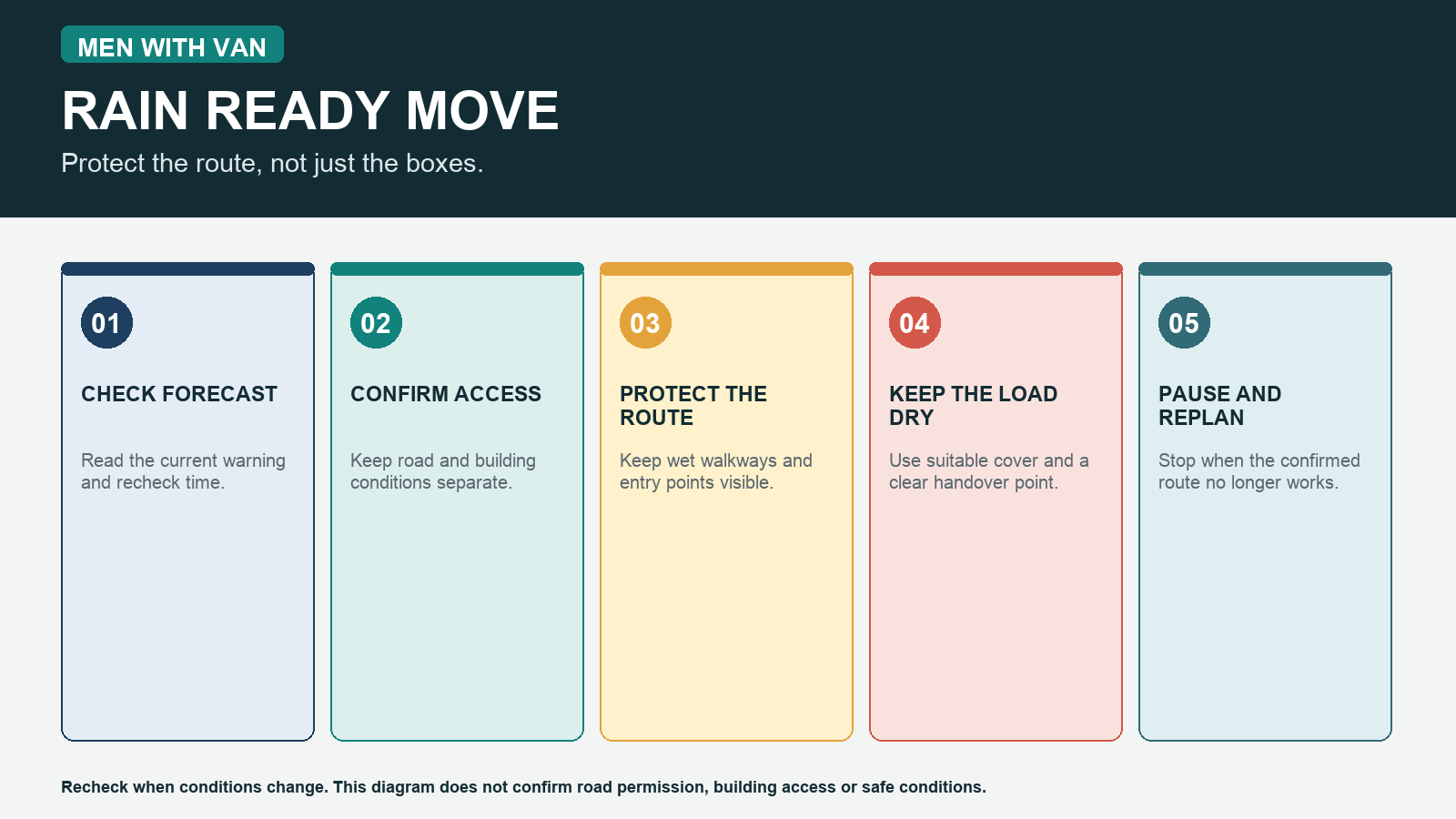
At a glance
What this guide helps you organise
- Check the current Met Office forecast and warnings close to the actual route and move window, then record when the next check will happen.
- Plan the pickup and destination separately because a lawful vehicle position or dry entrance at one address says nothing about the other.
- Keep entry routes, stairs, mats, floor protection and building rules visible so temporary protection does not create a new trip or access problem.
- Describe the load, cover, carrying route and handover point clearly instead of assuming every box or item can wait safely outside.
- Pause and ask Men With Van to review the operational plan when the confirmed conditions, access or service timing change.
Start with the actual window
Treat weather as a route question, not a yes or no question
A weather app can be useful for preparation, but a dry symbol or a rain symbol does not tell you whether the vehicle can wait, the entrance is available or the internal route remains workable.
Begin with the current official forecast and warnings for the move date, collection window and destination window. The Met Office says that its warnings describe the forecast weather type, likely impacts and related safety advice. A warning can be issued or changed at any time, so record when you checked, which locations you used and when you will check again. Do not copy an old screenshot into a moving record and assume it still applies.
Then turn the forecast into practical questions. Is the vehicle position lawful for the actual time? Is the road authority likely to have a restriction, closure or unsafe local condition that changes access? Does the building have an entrance procedure, concierge instruction, lift slot, loading bay or floor protection rule that applies in wet conditions? Is there a covered point where the team can hand items between the vehicle and building without blocking a public route or communal area?
Those questions belong to different people. The road authority controls its own road rules. A building manager or resident contact controls private entry arrangements. Men With Van reviews the moving operation, including the agreed service, vehicle, crew, access, load and timing. A forecast alone does not give any of those permissions. Record the named contact and the next update route for every uncertain point.
Use the London moving day parking guide to identify the authority responsible for the exact road and the red routes and loading guide where line, sign or bay evidence needs a separate check. Neither guide predicts the weather or turns a loading position into a waiting place.
Two address records
Check the pickup and destination separately
Rain can reach one address before the other, and the two properties may have different roads, carrying distances, buildings and decision owners.
Create one short record for the pickup and another for the destination. At each address, write the vehicle position, road authority, entrance route, building contact, available loading point, floor level, lift or stair route and the earliest time the team can begin. Add the current weather check and the next recheck time beside those access details. This makes it easier to see whether an issue applies to one address or both.
Do not assume the vehicle can wait at the destination simply because collection is delayed by a shower. A loading permission may be time limited, conditional or unsuitable for waiting. Equally, a dry entrance at the pickup does not mean the destination lobby, path or stairwell will be dry, open or suitable for an arrival at the planned time. Keep public road permission, private building approval and the internal carrying route as separate rows.
For a managed apartment, ask the building contact what its process requires. The key questions are whether the booked lift or loading slot still stands, whether it has a weather related protection rule, who must meet the team and what the building wants the resident to do if conditions change. The service lift and building access guide helps capture those building controlled details. It does not replace the building procedure or confirm that a lift is available.
For a house, note the gate, front path, hallway, stair, garden access and the distance from the lawful vehicle position. A longer carry in rain can change the route and timing even when the property has no formal building manager. Share the actual conditions with Men With Van before the plan is fixed rather than asking the crew to guess after the van arrives.
Keep the route visible
Protect entry routes without creating a new slip or trip risk
Temporary coverings, wet shoes, open doors and boxes can create hazards inside a property as quickly as rain affects the pavement outside.
HSE guidance on slips and trips explains that water, contamination, poor lighting, obstructions and unsuitable surfaces can all increase risk. Its manual handling guidance also makes clear that the task, load, environment and person handling it all matter. Apply that logic to the whole route rather than focusing only on a wrapped item. A narrow hall, wet tiled lobby, slippery external step, loose runner or crowded landing can change how the team must work.
Before the first item moves, clear loose boxes, bags, hoses, umbrellas and packaging from the carrying line. Check that any mat, protector or temporary surface covering lies flat and is appropriate for the property. Do not tape, wedge or place material where it blocks a fire route, door, stair, communal corridor or building requirement. If the building has its own protection or cleaning instruction, the building's current procedure is the deciding evidence.
Keep a simple rule for water transfer. Wipe or contain obvious water where this can be done without delaying a controlled route, and do not let people carry bulky items through a surface that has become unsafe. HSE guidance treats warning signs as a supplement to managing the condition, not a substitute for action. A sign or a message saying take care does not make a wet stair or obstructed route suitable for handling furniture.
Property condition needs its own record too. Use the protected goods removals guide to discuss the item preparation and route information Men With Van needs before a move. It does not promise that a covering prevents all damage or that every property surface is suitable for temporary protection.
Load control
Plan the load, cover and handover point before the rain starts
A cover only helps when the item, container, route, loading point and timing are understood together.
Tell Men With Van about items that are especially sensitive to moisture, awkward to carry, difficult to grip or too large to see around. HSE describes manual handling as more than lifting and notes that risk can increase when the load is bulky, unstable, difficult to grasp, carried over distance or handled in an awkward environment. That is why a soaked cardboard carton, a long carry or a slippery threshold should be a planning input, not an afterthought. If the evidence points to a piano, safe, artwork or another item that may sit outside ordinary removal handling, use the specialist mover assessment guide to record the item and both access routes before asking any provider to accept it.
Use closed containers where suitable, keep loose packing material out of the rain and prepare an agreed handover point before the vehicle is opened. Do not build an improvised pile on a pavement, communal corridor, lift lobby or loading bay while deciding what to do next. The place may be unsafe, obstructive or prohibited even when the goods are covered. A covered item still needs a lawful, clear route and a controlled place to wait.
HSE load security guidance highlights the need to manage loading and unloading risks, including vehicle and pedestrian separation, manual handling and secure loads. For a moving job, that means the team needs room to work, people should not walk through a live loading path and a changed route may need a revised sequence. Do not ask someone to rush, carry beyond their view or handle an unstable item simply to get out of the rain.
Use the actual item list, route notes and protection requirements when requesting a quote. The London moving costs and van calculator guide explains why item volume, access, movers, vehicle and booked time are all part of a planning estimate. It does not create a fixed wet weather service plan.
Make the stop signal clear
Set pause triggers before the vehicle is loaded
A pause is not a failure. It is the right status when the information that supported the plan has changed or a named owner has not confirmed the next step.
Agree in advance what needs a call back to Men With Van. Examples include a new Met Office warning that changes the expected conditions, a closed or flooded route, a road restriction, a building that withdraws a loading or lift slot, a wet surface that cannot be managed safely, a blocked entrance or an item that cannot be kept protected through the revised route. Record the trigger, who owns the answer and the next review time.
| Change | Record before acting | Decision boundary |
|---|---|---|
| Forecast or warning changes | Check time, location, expected impact and next review time | A forecast does not confirm the route or service decision |
| Road or parking change | Exact position, authority, sign evidence and lawful fallback | Loading permission does not automatically allow waiting |
| Building access change | Named contact, slot, lift, entrance and protection requirement | Private approval does not replace road rules |
| Route or load condition changes | Surface, carrying route, item concern and workable handover point | Do not rush handling to preserve an old timetable |
Use proceed only when the confirmed access and moving plan remain workable. Use pause while a named contact or Men With Van reviews an open question. Use revised plan when the vehicle position, timing, crew, item handling, route, storage need or service scope must change. Do not turn silence, an optimistic time estimate or a covered box into approval.
When the move involves a difficult flat route, use the fourth floor flat move guide to identify access and handling information before the day. It does not say that stairs are a replacement for an unavailable lift or unsuitable wet route.
Original planning aid
Use one rain ready route record instead of scattered messages
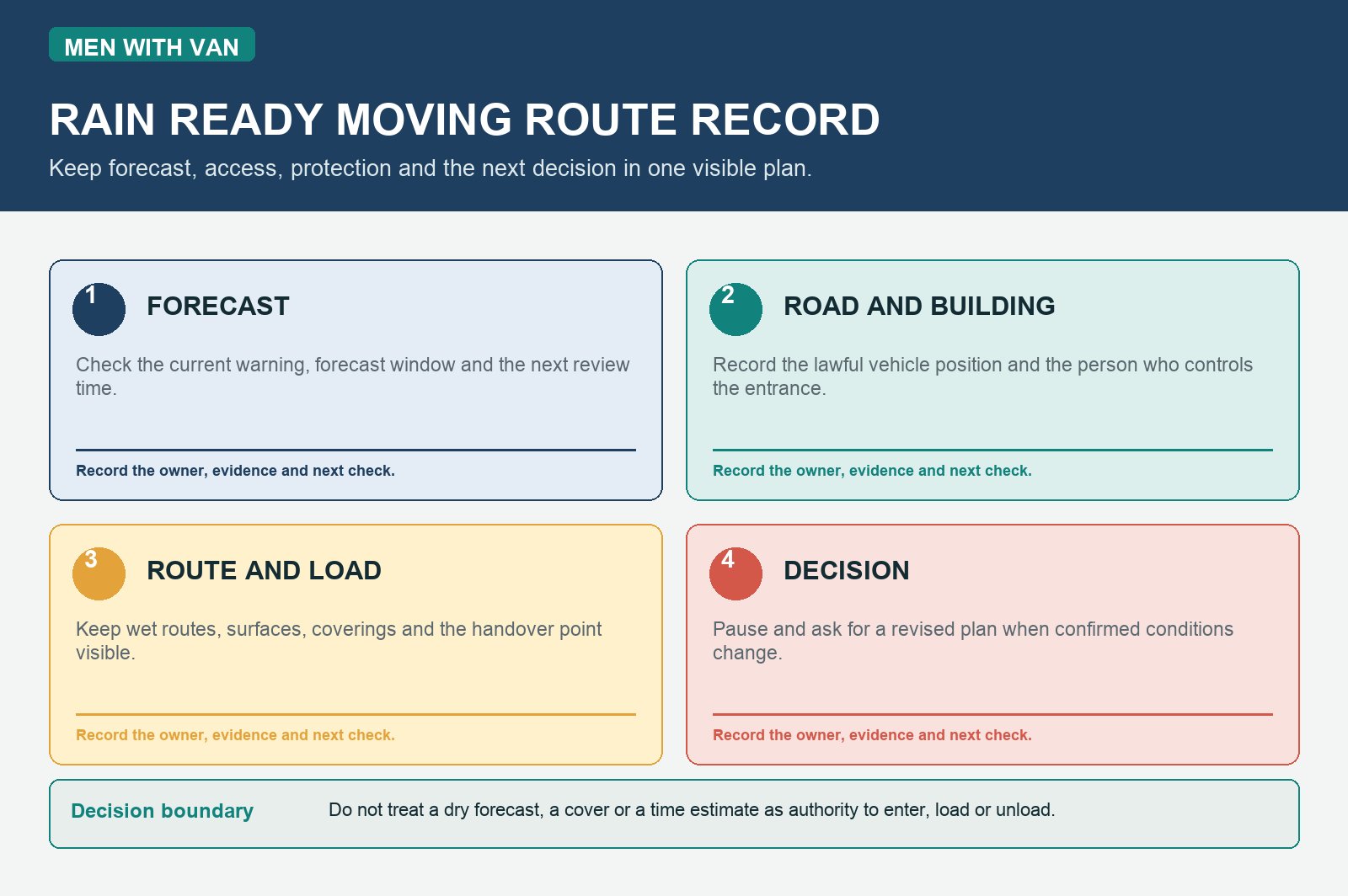
A short record helps the customer, building contact and moving team distinguish a known condition from an unresolved question without storing unnecessary personal information.
Download the Men With Van rain ready moving route record as a fillable PDF. The two page record keeps the move date, addresses, forecast check, next review time, lawful vehicle position, building contact, route condition, load protection and pause decision in one place. It is designed to be filled in with the people who control the relevant information, not used as a generic permission slip.
Keep sensitive information out of it. The record does not need bank details, access codes, identity documents or private building security information. Record the name or role of the contact, the relevant approval or condition, the communication route and the next action. Send access codes only through the approved private route to the people who genuinely need them.
Attach the actual building confirmation, authority reference or current weather message where appropriate rather than rewriting it from memory. The record should show what is known, what is pending and when the next check happens. It does not certify a surface, reserve a bay, approve a lift, authorise entry or confirm a booking change.
For an office move, use the small office removals guide alongside the record so the building manager, loading contact, equipment owner and moving team can keep their decisions distinct. A property team should still follow its own live safety and access procedure.
Quote and service boundary
Keep timing and service changes explicit
Weather can change the operational facts of a booking, but it does not automatically create extra time, a new vehicle window, storage, a different route or a confirmed price.
Tell Men With Van as soon as the route or access assumption changes. Share the latest weather check, exact address, floor level, vehicle position, building contact, load concern, available handover point and the time when a decision is needed. Men With Van can then review what is workable within the actual booking and explain when a revised service, time or plan would be needed.
Do not ask the crew to work through conditions that are outside the agreed route, access or handling plan. A change may require waiting, a different sequence, more time, a different vehicle position, a new booking arrangement or another solution. No new service is confirmed until Men With Van has reviewed and agreed it through the proper booking route.
For the strongest quote, use clear records before moving day and update them when the facts change. The House Removals London planning page lists the practical details that make a route, crew and vehicle plan more accurate. A carefully prepared record helps the team make a decision, but it cannot guarantee the weather, traffic, building access or road availability.
Sources and checks
Official guidance used for this wet weather planning guide
Weather conditions can change quickly. Treat these sources as a planning prompt, then check the current Met Office warning, road conditions and building rules for each address and move window.
- Met Office weather warnings guideChecked 3 August 2026
- HSE manual handling at workChecked 3 August 2026
- HSE slips and trips in outdoor and wet conditionsChecked 3 August 2026
- HSE load security guidanceChecked 3 August 2026
Common questions
Wet weather moving questions with practical boundaries
Should I cancel a move when rain is forecast?
There is no single answer. Check the current Met Office forecast and warnings, the actual road and building access at both addresses, the item and route conditions, and the booking position with Men With Van. A forecast alone does not decide whether a move can proceed.
How should I protect floors during a wet weather move?
Keep the route clear, identify wet or slippery surfaces, use appropriate protection only where the property permits it, and avoid creating loose edges or blocked routes. Follow any current building procedure and pause the handling plan if the route cannot be managed safely.
Can a removal vehicle wait in a loading bay until rain eases?
Do not assume so. A loading permission may have different conditions from waiting, and the exact sign, bay, authority and time matter. Check the responsible road authority and the current local restriction before treating any position as a fallback.
Will a cover keep every item safe from rain?
No. Protection depends on the item, packaging, handling, route, exposure time and the controlled handover point. Tell Men With Van about moisture sensitive, awkward or fragile items so the actual plan can be reviewed instead of relying on a general promise.
Plan the real route
Share the route, access and item details before changing weather reaches moving day.
Include both addresses, floor levels, carrying route, vehicle position, building contact, weather concern, item list and the decision time so Men With Van can review the actual move rather than a generic forecast.