London moving logistics
London moving day parking: suspensions, access and loading
A practical guide to working out who controls the road, whether a bay needs to be reserved, what continuous loading means and which details your removal team needs before travelling.
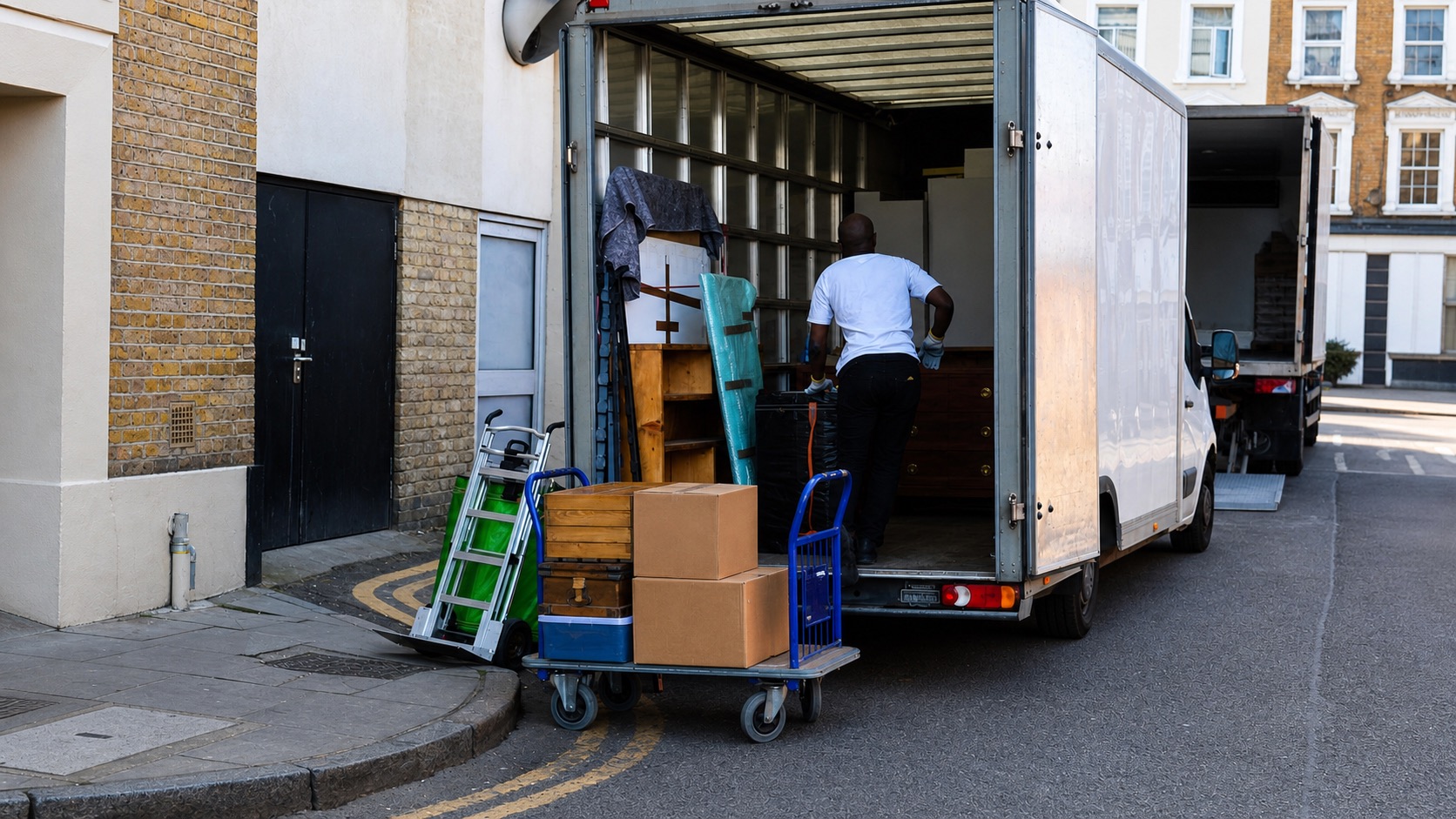
At a glance
What this guide helps you organise
- Identify whether Transport for London or a borough council controls each road.
- Do not treat a loading exemption as a guaranteed reserved space.
- Arrange separate parking and access plans for pickup and delivery.
- Send the confirmation, location and building instructions to the moving team before travel.
- Check live signs and current authority guidance again on moving day.
Start with the authority
Find out who controls the road at each address
The first useful question is not simply whether parking is difficult. It is whether the road is managed by Transport for London, a London borough or a private landowner.
Red routes are managed by Transport for London. Most other public roads are managed by the relevant borough, while an estate road, loading court or private car park may have its own managing agent. The colour of the lines, nearby signs and the exact part of the street matter more than the postcode alone.
Use the TfL red route information and map when red lines are present. For a borough road, the GOV.UK council finder is a reliable starting point. Repeat the check for the delivery address because two ends of one move can be controlled by different authorities.
Choose the right permission
Understand the difference between loading, a suspension and a dispensation
These terms are related, but they do not give the same certainty. Choosing the wrong one can leave a removal van with permission to load but no practical space to stop.
| Arrangement | What it usually means | Main limitation |
|---|---|---|
| Loading exemption | Loading may be allowed where the signs and markings permit it while goods are actively being moved. | It does not reserve a space and the allowed time or location can be restricted. |
| Parking bay suspension | A controlled bay or group of bays is taken out of normal use for the approved purpose. | The application, notice, vehicle rules and charges vary by authority. |
| Dispensation | The authority gives specific permission to park contrary to a restriction in defined circumstances. | It applies only to the approved vehicle, place, date and conditions. |
| Private access booking | A concierge, estate or building manager reserves a loading bay, lift or service entrance. | It does not override public road restrictions outside the property. |
The London Councils loading guidance explains that loading must be genuine and that restrictions still apply. If the purpose is to keep a particular space free for a Luton van, a formal suspension is usually the clearer route where the authority offers one.
Allow enough time
Apply early and use the current borough instructions
There is no single London notice period, price or application form. The authority for the exact road decides what can be requested and how much notice it needs.
Current council examples show why it is risky to rely on a general rule. Ealing says not to use its standard form for a suspension starting within three working days, while the current Richmond page contains both ten working days and seven working days as general guidance. The 33 authority suspension notice comparison preserves that conflict and links to each current council source. The separate London removal parking fee comparison records the public cost for one consistent domestic moving scenario. Camden explains separate domestic removal treatment for the first day, but its administration conditions still apply. These examples can change and they are not rules for another borough.
Once the moving date is reasonably firm, check both addresses and start the applications. Keep the confirmation email, reference, approved location, dates, times and any vehicle registration requirement together. If the application asks for a plan or photograph, mark the exact frontage and direction of travel rather than describing a broad stretch of road.
- Use the live authority page, not an old forum answer or screenshot.
- Confirm how many spaces or metres are needed for the actual vehicle.
- Check whether signs are installed by the authority or must be collected.
- Read the amendment and cancellation conditions before paying.
Plan the physical job
Reserve usable space, not just any nearby bay
A space can be legally reserved and still be poor for the move. The van needs a safe position, a workable rear loading area and a clear carrying route to the property.
A full size removal van occupies more road length than a car and the crew needs room to open the rear, use a trolley where suitable and carry items without blocking a crossing, cycle lane, entrance or pavement. Vehicle dimensions vary, so use the confirmed van information and the authority's bay measurement method rather than guessing.
Look at bends, bollards, trees, scaffolding, school restrictions, bus stops, cycle lanes and the distance between the kerb and the entrance. For a London house removal, a long carry can add repeated walking time across every item. For a London office removal, a booked service yard may be more important than the nearest street bay.
Know the loading rule
Continuous loading is activity, not waiting time
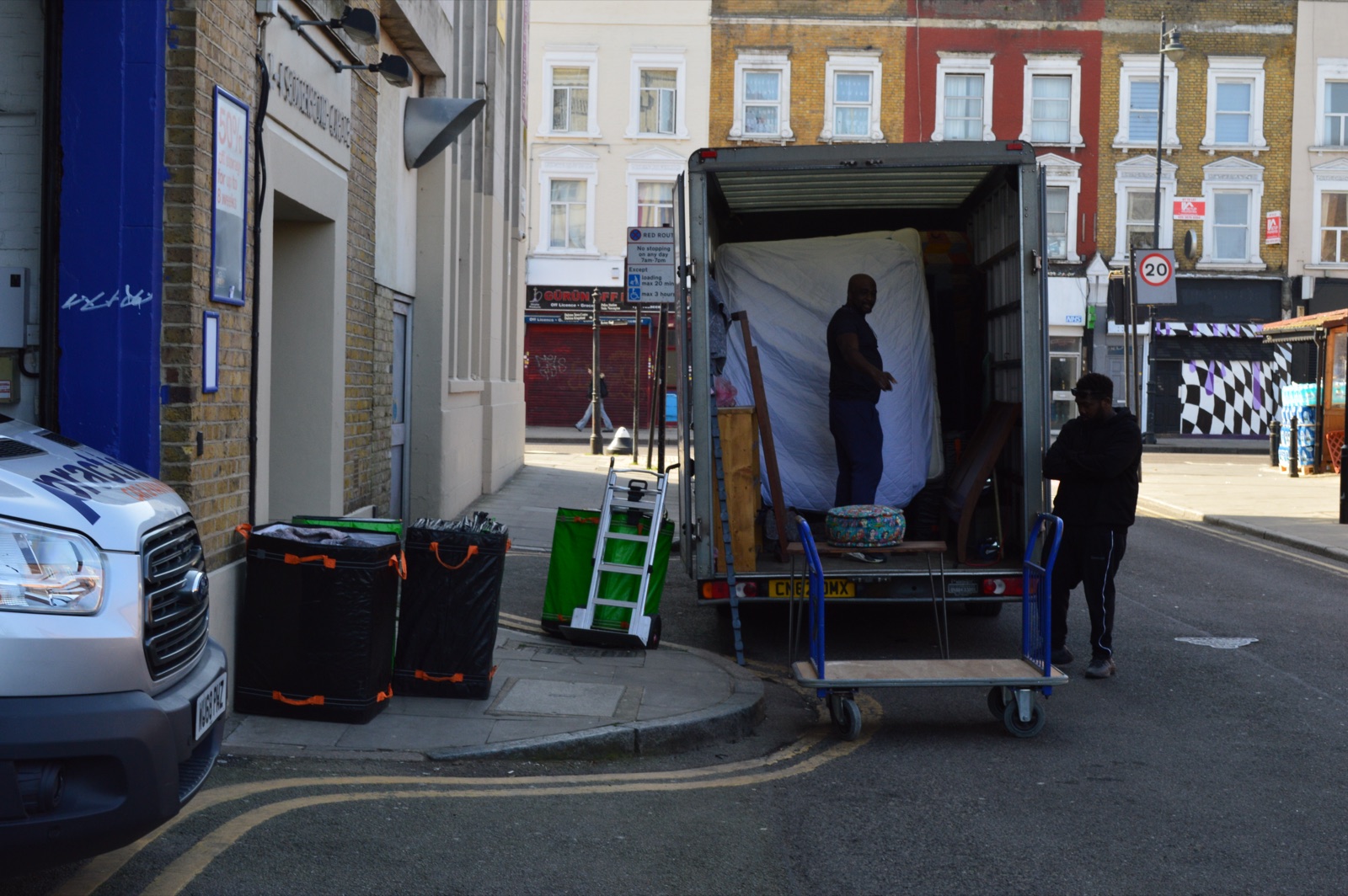
Where loading is permitted without a reserved bay, the vehicle must be there for the movement of goods. The exemption is not general parking for preparation, breaks or waiting for keys.
London Councils advises that the vehicle should move as soon as loading is complete and that kerb markings, signs, clearways and red route rules must still be observed. Time limits can differ by location. A civil enforcement officer may look for evidence that goods are genuinely moving between the property and vehicle.
Keep the move organised so activity is clear. Boxes should be ready, access should be open and the route should not be used for last minute sorting. Useful records can include the booking confirmation, inventory, property addresses and parking approval. They do not create permission, but they help explain the purpose of the stop if the authority asks.
Never assume that double yellow lines automatically allow a removal van to stay. Loading bans, kerb markings, red route controls and local signs can change the answer.
If property access depends on legal completion or authorised key release, use the completion day moving delay plan to record who can confirm each stage, the lawful waiting position and the next decision time. The guide does not turn a loading exemption into waiting permission.
Road and building together
Coordinate the bay with lifts, keys and building access
Good parking cannot rescue a move when the service lift is unavailable, the concierge has no booking or the crew cannot enter the loading area.
Ask the building manager whether moves are restricted to set hours, whether a lift must be protected, whether a certificate or vehicle registration is required and which entrance the team must use. Confirm the key collection plan and who can open gates at both properties.
Match the parking window to the building window with enough overlap for loading and unloading. If the bay begins at 9:00 but the lift is only available from 11:00, the vehicle can lose useful time. These details also help a man and van London service decide whether the booked hours are realistic.
- Lift or loading bay booking reference
- Concierge or site contact number
- Gate, height and vehicle restrictions
- Floor protection or access requirements
- Keys and handover timing
Pickup and delivery
Build a separate access plan for both ends of the move
The move is only as smooth as its more difficult address. A clear pickup plan can still lead to delay when the delivery road or building has not been checked.
Create two short access notes. For each one, record the responsible authority, approved parking position, time window, floor, lift, stairs, carrying distance, entry contact and any item that needs a special route. Add an alternative lawful position in case access changes, but do not assume that an alternative is permitted without checking.
If the move includes storage or an extra stop, treat that as another address. The Men With Van service area guide explains the wider London and UK coverage, while the online quote should contain every planned stop. Missing stops and long carries can affect moving service prices because they change the real time and route.
Parking permission does not settle a London road user charge. Use the Congestion Charge and ULEZ planning record for the actual route, date and registration. That record does not grant a parking bay, loading permission or building access.
Final confirmation
Send the evidence and access note before moving morning
A useful confirmation tells the moving team exactly where it can stop and who to contact. A message that only says parking sorted leaves important questions unanswered.
Send the approved location, date, times, reference, vehicle rule, sign photograph where available and the building contact. Mention any change from the original quote, including scaffolding, a broken lift, a longer carry, road works or a new key collection time. The team can then compare the live plan with the booking.
If another vehicle blocks a suspended bay, follow the authority's instructions and contact its enforcement service. Do not move another person's vehicle or turn the situation into a confrontation. Tell Men With Van promptly so the driver can consider a lawful alternative while the authority responds.
- Check the signs at pickup and delivery.
- Photograph the approved space and nearby restrictions.
- Keep the authority and building contacts available.
- Make sure boxes and access are ready for active loading.
- Update the quote if the carrying distance or timing has materially changed.
Make the quote realistic
Let the quote reflect the actual parking and access
Professional movers in London need usable detail before the job, not after the van arrives. Parking and access can change the time, team movement and order of work.
A van close to the entrance reduces repeated carrying. A distant bay, several flights of stairs, a small lift or a timed loading court can extend the move even when the route mileage is short. These are planning facts rather than surprise extras, which is why the Men With Van quote asks for floor and access information.
When requesting a Men With Van moving quote, include both postcodes, every stop, the item list, floor levels, lifts, stairs, expected carrying distance, parking arrangement and moving date. Upload clear photos or a walkthrough when the layout is difficult to describe. The result is a more useful plan for the van, movers and booked hours.
This guide explains the parking process but does not grant permission to stop. The road signs and written approval from the responsible authority remain the deciding information on the day.
Journalists and property teams comparing London access rules can use the London moving source library for related guides and the current contact route. The library does not replace the responsible authority or the signs at the exact location.
Sources and checks
Official guidance used for this article
Rules, application times and charges can change. Check the road signs and the responsible authority again before moving day.
- Transport for London: red routesChecked 29 July 2026
- GOV.UK: find local parking permit informationChecked 29 July 2026
- London Councils: loading and unloadingChecked 29 July 2026
- Camden Council: parking bay suspensionsChecked 29 July 2026
- Ealing Council: apply for a parking suspensionChecked 29 July 2026
- Richmond Council: parking suspensionsChecked 29 July 2026
- Kensington and Chelsea: moving house suspension questionsChecked 29 July 2026
Common questions
Moving day planning questions
Do I always need a parking suspension for a London house move?
No. The answer depends on the road, restrictions, expected loading time and whether a suitable lawful space is likely to be available. A suspension is useful when a specific controlled bay needs to be kept clear, but the responsible authority should confirm the correct arrangement.
Can a removal van load on double yellow lines?
Loading may be permitted on some yellow line locations when there is no loading ban and goods are actively moving, but signs, kerb marks, obstruction rules and local conditions still apply. Check the exact location rather than relying on the yellow lines alone.
Who handles a suspension on a London red route?
Transport for London manages red routes and provides its own information about red route rules and dispensations. Borough council parking permission does not replace approval required for a TfL managed road.
How many parking spaces should I reserve for a Luton van?
Use the confirmed vehicle dimensions and the authority's measurement method. The position must also leave a safe and practical rear loading area. Do not estimate the requirement from a standard car bay without checking.
What should I send the removal company before moving day?
Send the approval reference, exact location, date and time, any vehicle registration condition, a sign or location photograph, building contact, lift booking and any change to stairs, carrying distance or access.
Plan the real move
Share the route, access and move details before the van sets off.
Include every address, floor level, lift, loading distance, parking arrangement, item volume and building time slot so the quote and move plan reflect the actual job.