One decision record for a changing day
Completion day moving delay contingency plan
A completion date tells you which day the transaction is due to complete. It does not give a removal crew legal confirmation, release the keys or guarantee one arrival time. Use this plan to keep the legal decision, the key handover and the moving operation visible without guessing.
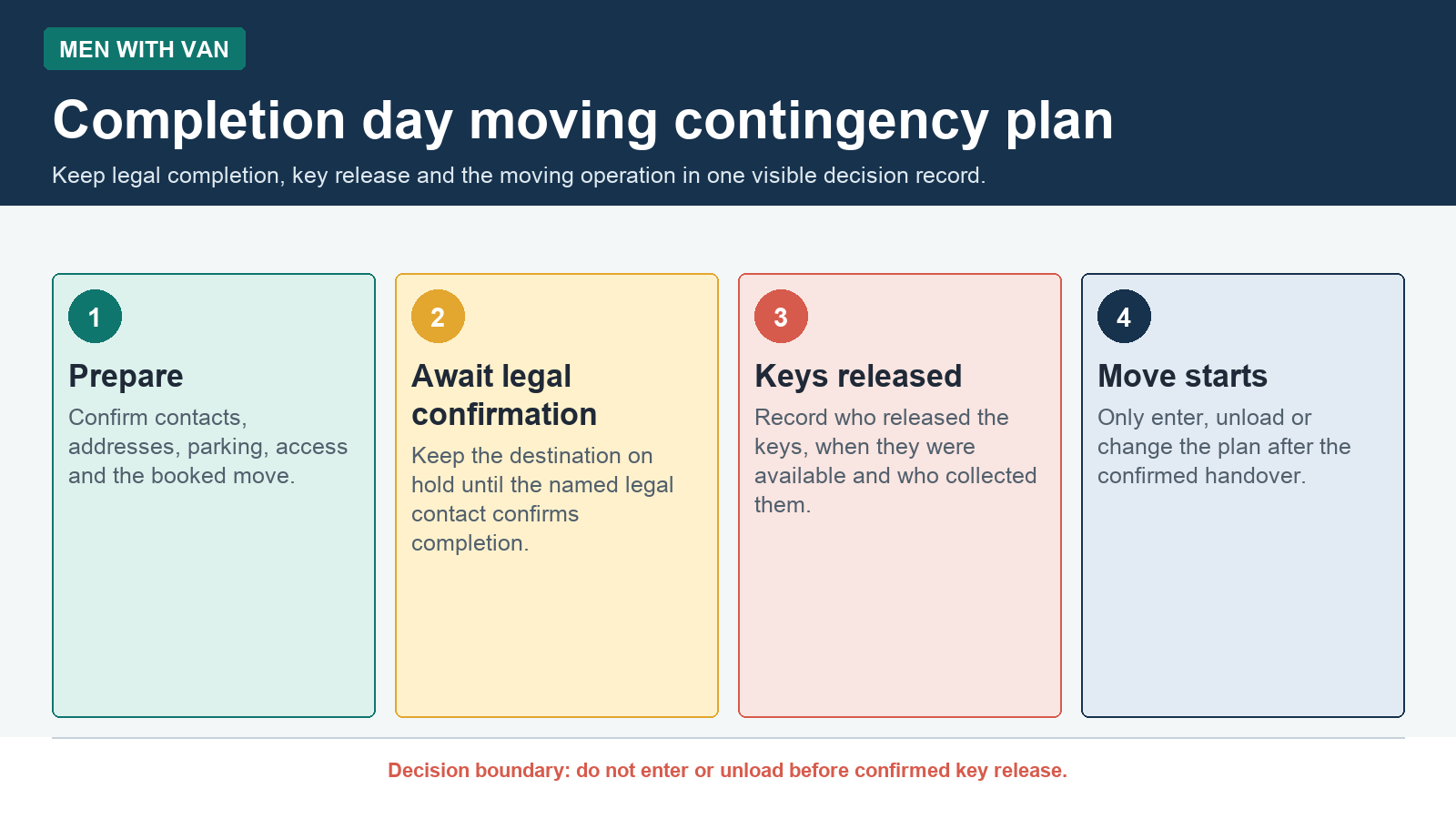
At a glance
What this guide helps you organise
- Treat legal completion, key release and the moving operation as separate decisions with named owners.
- Record a lawful waiting position and keep the destination on hold until the authorised contact confirms release.
- Give the old property and destination their own access, parking, key and condition records.
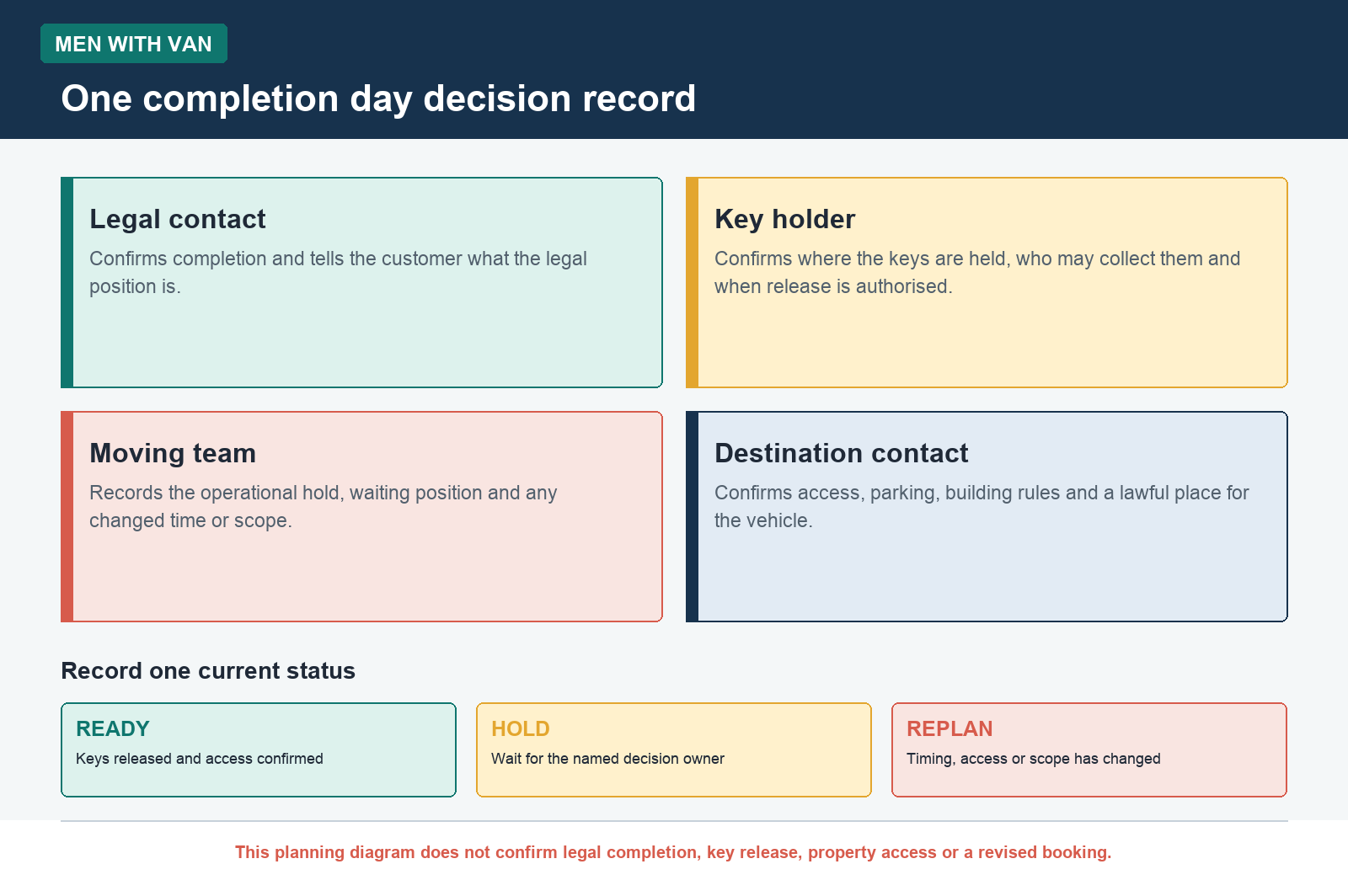
- Use READY, HOLD or REPLAN as the current operational status, with evidence and a next update time.
- Ask the legal representative about the legal position. This guide does not provide legal advice or change a booking.
Start with the decision boundary
Separate legal completion from the moving operation
The transaction can have an agreed completion date while the moving team still lacks the confirmation, keys or access needed to enter and unload.
For a residential purchase in England and Wales, GOV.UK explains that the contract records when the sale will complete and that the agreement becomes legally binding when contracts are exchanged. It also describes completion as the stage when the legal representative transfers the money, the seller moves out, the buyer receives the keys and ownership changes. Read the current GOV.UK conveyancing sequence with your legal representative because the contract and transaction decide the legal position.
The moving operation needs a separate control point. An expected completion time, a provisional estimate or the presence of a loaded vehicle outside the destination is not authority to enter. Record the person who will confirm completion, the person authorised to release the keys and the contact who controls any building or gated access. Until those contacts provide the required confirmation, mark the destination HOLD.
This separation protects everyone from a vague instruction such as proceed as planned. The legal representative answers the legal question. The estate agent, seller or other authorised key holder confirms the key handover route. Men With Van reviews the operational position, including the vehicle, goods, access, time and agreed service. None of those contacts should be presented as having approved a decision that belongs to another person.
Four named contacts
Name every decision contact before moving day
A contingency plan works only when the customer and moving team know who can answer each question and how the next update will arrive.
Record four contacts in advance. The first is the solicitor, licensed conveyancer or other legal representative handling the transaction. The second is the person holding or releasing the keys, often the estate agent or seller. The third is the Men With Van moving contact. The fourth controls destination access, such as the resident, concierge, building manager, landlord or authorised site contact.
For each contact, record a known telephone number, the expected communication route and any useful reference. Do not copy bank details, access codes or unnecessary personal information into the moving record. GOV.UK warns that criminals can imitate legal representatives and request money through changed bank details. If a message concerns money or claims that a known payment route has changed, stop and contact the legal representative through a number already verified independently.
Set an update rhythm without promising a completion time. For example, the customer may agree to contact the legal representative at a stated review point and then update the moving contact. If there is no new legal information, record no change rather than converting silence into approval. The next review time should be realistic for the vehicle position, crew, booked work, access rules and any other jobs that may be affected.
Keep the contact record with the clear booking records guide so the address, item list, scope and decision owner stay together. A single current record is safer than several unlabelled screenshots that may contain different times or instructions.
Two address records
Plan the old property and destination separately
A delay at the destination does not remove the customer's obligations, access limits or handover tasks at the property being left.
Create one short record for the old property and another for the destination. At the old property, confirm the agreed time for leaving, the key handover route, final condition evidence, meter readings, parking and any building access deadline. At the destination, confirm the legal completion contact, key release point, lawful vehicle position, building procedure, lift or concierge requirement and the earliest authorised access.
GOV.UK advises buyers to inform the removal company of the move date between exchange and completion. Its home buying guide also notes that delays in a chain can mean access arrives later than expected and that removal company policies should be checked in advance. That makes the booking terms, waiting arrangement and changed scope part of the preparation, not a discussion that begins only after the vehicle is loaded.
Do not surrender old property keys early merely to simplify the timetable. The customer should follow the contract, tenancy, agent or landlord instruction that applies. Likewise, do not leave furniture in a communal corridor, public footway, unapproved loading area or destination lobby while waiting. Use the London moving day parking guide for the road evidence and the service lift and building access guide for managed property controls.
If the old property must be cleared before the destination becomes available, decide where the vehicle and goods may wait lawfully and safely. Record whether the planned position permits waiting, whether the crew can remain there, how access will be maintained and who will authorise a different plan. A loading permission is not automatically a waiting permission.
Original decision aid
Build one completion day decision record
The record should show the current status, the evidence behind it, the named owner and the next review time without hiding an unresolved question.
Use READY only when the legal confirmation needed for the move has arrived through the agreed route, the keys are released or available as required, and the destination access plan remains valid. Use HOLD while the team is waiting for a named decision owner. Use REPLAN when the timing, vehicle position, access, resources, storage requirement or agreed service must change.
| Record item | Evidence to capture | Decision owner | Operational result |
|---|---|---|---|
| Legal completion | Name, time, known contact route and reference where supplied | Customer and legal representative | HOLD until the required confirmation is received |
| Key release | Who holds the keys, collection location, release time and collector | Authorised key holder and customer | No entry before release |
| Destination access | Parking, entrance, building contact, lift and lawful waiting position | Customer and access controller | HOLD or REPLAN if the route changes |
| Moving operation | Vehicle, goods, crew, booked time, scope and latest instruction | Men With Van moving contact | READY only for the confirmed operational plan |
Add one next update time and one action owner for every open row. If the next update passes without an answer, keep the status visible and review the operational consequences. Do not delete the earlier time or pretend the delay did not occur. A short history can help the customer, agent and moving team understand which instruction was current.
Vehicle and goods control
Choose a lawful waiting plan before the vehicle is loaded
A useful contingency plan identifies where the vehicle, crew and goods can remain and what happens when the original position or time is no longer workable.
The safest waiting plan is specific to the route, vehicle and permission. Record the proposed place, the authority or property owner controlling it, the conditions and a fallback. A removal vehicle that has finished genuine loading may not be entitled to remain in a loading place. Red routes, bays, yellow lines, private estates and managed buildings can all apply different controls.
Keep the goods in a controlled place. Do not unload them onto a pavement, corridor, entrance, shared stair, lobby or loading court merely because key release is delayed. If the vehicle must move, tell the customer what is changing and let Men With Van review the route, time, resources and scope. The red routes and loading bays guide explains how line, kerb, bay and sign evidence should be read for one place and time.
Record practical welfare and safeguarding needs as well. The crew needs a lawful, workable plan, and the customer may have children, pets, medication, mobility needs or essential property in the load. Keep a separate essentials bag with the customer rather than burying it inside the vehicle. Do not store identity documents, house keys, medication or irreplaceable items in an uncertain part of the load.
If the delay is likely to outlast the workable booking window, move from HOLD to REPLAN. Ask the moving contact about the actual options and applicable booking terms. Storage, an additional journey, a different crew window or a new date may require a revised service. Do not promise availability or price before that review is complete.
Three operational levels
Use three contingency levels instead of one vague fallback
A short wait, an extended delay and a move date change create different decisions, so each level needs its own trigger and owner.
Define the levels before moving day. A short delay may allow the vehicle and crew to remain in the confirmed waiting plan without affecting another access window. An extended delay may require a changed vehicle position, crew sequence, additional time, storage question or contact with the other property. A move date change requires a fresh booking, access, parking, key, storage and accommodation plan.
| Level | Use it when | Record before acting | Boundary |
|---|---|---|---|
| Short delay | The current vehicle, crew, goods and access plan remain workable | Lawful waiting position, next update time and named contact | Do not enter or unload without release |
| Extended delay | The original timing or waiting plan is becoming unworkable | Changed time, access, resources, scope and customer instruction | Men With Van must review the operational change |
| Move date change | Completion or authorised access will not support the booked move | New legal update, storage, accommodation, parking, access and revised booking | No new service is confirmed until agreed |
Keep the trigger factual. A customer feeling worried is a reason to communicate, but it does not itself establish that completion has failed. Equally, an optimistic estimate is not a reason to ignore a waiting limit. The named legal and operational contacts should each answer the question within their control.
For a house move with several route constraints, use the House Removals London planning page to record parking, doors, stairs, garden or garage contents and the actual carrying route. A contingency plan cannot repair missing access evidence that should have been gathered before the date was fixed.
Secure communication
Protect the legal contact route and payment information
Completion day combines urgency, large payments and many messages, so the moving record should reduce confusion without collecting sensitive financial information.
Keep bank details out of the moving record. Men With Van does not need the customer's purchase money information, mortgage account or conveyancer bank instructions to plan the removal. The operational record needs the completion status, key release route, access status, current hold decision and next update.
The GOV.UK home buying guide warns about payment diversion fraud and advises contacting the legal representative through a known number if bank details appear to change. Apply the same discipline to an unexpected completion message. Verify the sender through the contact route established before moving day. Do not rely only on the telephone number or link contained in the new message.
Limit personal information to what the move requires. Record names, contact roles, relevant telephone numbers, addresses, access status and decision times. Do not place alarm codes, key safe codes, passport details, bank information or unrelated legal documents in a sheet that may be shared with several operational contacts. Send building access codes only through the approved private route and only to the people who require them.
If the customer needs legal advice about delay, breach, compensation, contract obligations or the right to enter a property, direct the question to the legal representative. This guide and the fillable record are moving coordination tools only.
Property records
Record keys, meters and condition at the correct handover point
A delayed day can blur the boundary between leaving one property and taking control of another, so time stamped records should follow the authorised handover.
At the old property, follow the contract, tenancy, agent or landlord instruction for clearing the premises, final photographs, meter readings and key return. Citizens Advice states that a seller should arrange to leave the house empty by completion day and hand over all keys. The legal representative should answer any question about what the contract requires in the actual transaction.
At the destination, wait for the authorised release before entering or directing goods inside. Once access is confirmed, record the key collection, condition questions and meter readings that apply. GOV.UK recommends meter readings when leaving the current property and arriving at the new one, with a dated photograph as useful evidence.
Keep the evidence proportionate. Photograph the meter display, visible condition or agreed access point, not unrelated personal property or neighbours. Label the address, date and purpose so images from the two properties cannot be confused. A condition photograph does not alter the legal position or prove responsibility for a defect.
When building management controls the destination, compare the live entrance, lift, loading position and concierge process with the approved record. If the route differs, pause and update the high rise apartment dependency register before handling continues.
Reusable record
Download the record and send one current handover
The fillable record brings the contacts, status, evidence, waiting plan and contingency decision together without presenting the sheet as legal confirmation.
Download the completion day moving contingency record and complete it before the move date. Page one records the two addresses, customer, named decision contacts, preparation checks and current status. Page two records legal confirmation, key release, the operational hold, the contingency level and final handover.
Keep only one current copy. Add the time of every meaningful update, state who supplied it and keep unresolved questions visible. Send the relevant operational record to Men With Van without attaching confidential conveyancing papers. If the destination, vehicle position, access, goods, crew window or scope changes, let the moving contact review the effect before treating the new plan as agreed.
The moving service price guide explains how time, movers, vans, distance, stairs, parking and access affect the actual quote. A completion day delay may change one or more of those inputs. The record helps identify the change, but it does not calculate a charge, waive terms or promise a replacement date.
Editors, estate agents, property managers and housing teams may link to this guide or use the blank record as a planning reference with clear attribution. Request permission before republishing the full form, substantial passages or images. The Men With Van media and expert resources page provides the current contact route and related source checked material.
Sources and checks
Official guidance used for this article
Home buying and completion processes can differ by transaction and jurisdiction. Ask the legal representative for the current legal position and review source updates before relying on this guide.
- GOV.UK: transferring ownership when buying a homeChecked 29 July 2026
- GOV.UK: how to buy a homeChecked 29 July 2026
- GOV.UK: making an offer when buying a homeChecked 29 July 2026
- Citizens Advice: selling a homeChecked 29 July 2026
Common questions
Completion day moving delay questions
Can the removal crew unload before the buyer receives the keys?
Do not assume so. Keep the destination on hold until the required legal confirmation and authorised key release have arrived through the agreed route and the access plan remains valid.
Does the completion date guarantee a time for moving in?
No. The date identifies the agreed completion day, but funds, legal confirmation, the transaction chain, key release and property access can affect when entry becomes authorised.
Who should confirm whether legal completion has happened?
Ask the solicitor, licensed conveyancer or other legal representative handling the transaction. The removal company can record the operational status but cannot give legal confirmation.
What should I do when the key release is delayed?
Keep the move on HOLD, use the known contact route, record the lawful waiting position and next update time, and tell Men With Van before the timing, access or scope becomes unworkable.
Can Men With Van keep the goods overnight if completion moves?
That depends on the actual vehicle, crew, storage option, booking terms and availability. Ask the moving contact to review the changed requirement before treating storage or a new date as confirmed.
Does this guide cover the legal process in Scotland or Northern Ireland?
No. The cited home buying sequence is for England and Wales. Legal processes differ, so ask the legal representative for the rules and decision points that apply to the actual transaction.
Keep one current record
Send the confirmed move and access record before the vehicle plan changes.
Give Men With Van the current addresses, item list, access evidence, legal status supplied by your representative, key release route, lawful waiting position and every operational change that needs review.