Two building dependency register
High rise apartment removals: coordinate both buildings
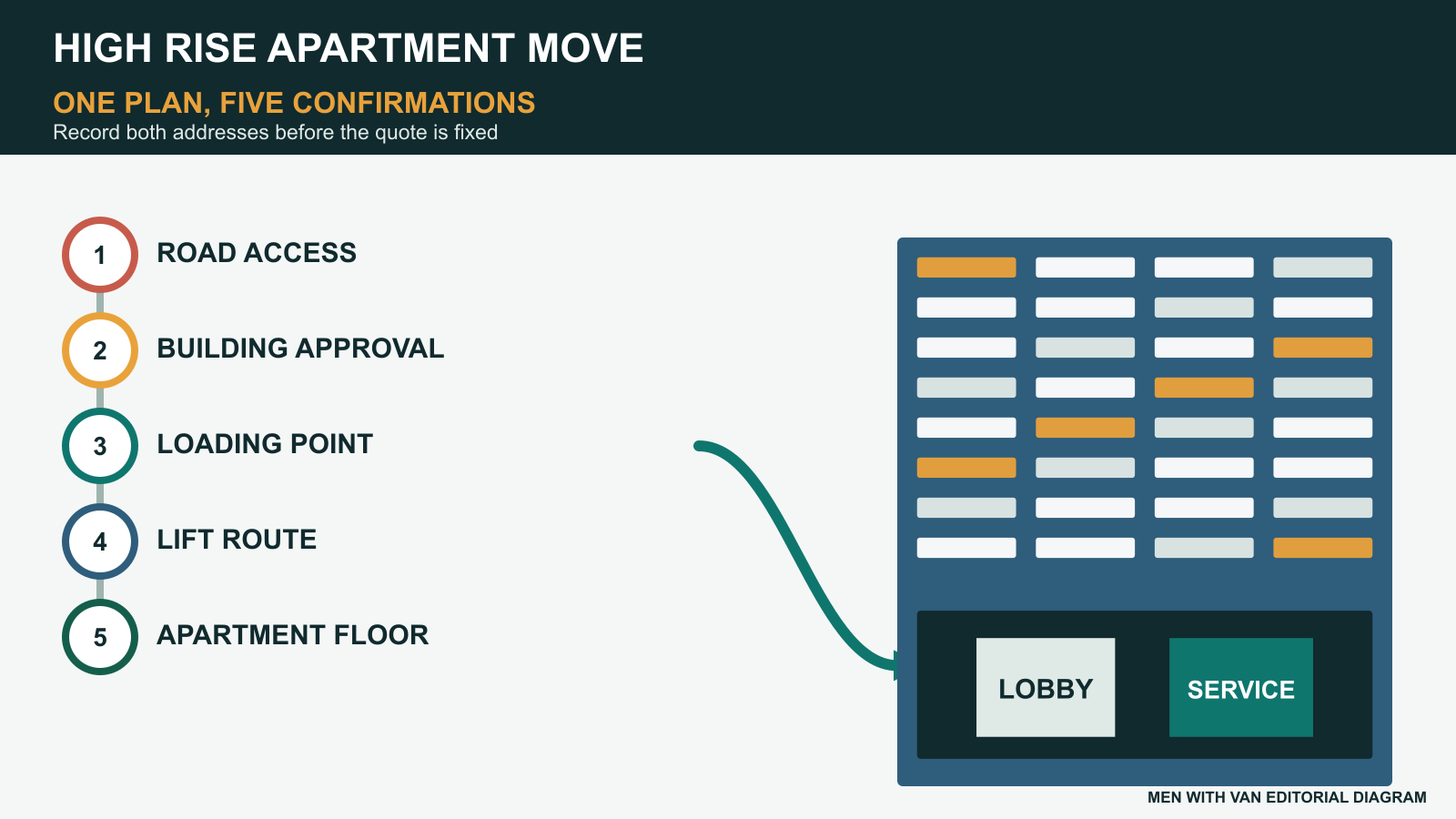
A high rise move depends on two separate chains of access. Record the road position, building approval, loading point, lift route and apartment floor at both addresses before the plan is fixed.
At a glance
What this guide helps you organise
- Open a separate control record for the pickup building and the delivery building.
- Keep public road permission, private building approval, loading access and lift booking as separate confirmations.
- Trace the complete route from the lawful vehicle position to the apartment, including every door, turn, surface and change of level.
- Pause the plan when a required confirmation is missing, contradictory or different on the day.
Start with separation
Open one control record for each building
Pickup and delivery are separate access systems, even when both properties are managed apartment buildings with a concierge and a lift.
Create a clearly labelled record for each address before asking for a fixed removal plan. Record the building name, full address, apartment floor, entrance to be used, management contact, concierge contact, resident contact and the date each detail was confirmed. Keep photographs and messages inside the correct address record so an approval for one building cannot be mistaken for permission at the other.
List five confirmation groups for each address: public road access, building approval, loading point, lift route and apartment floor. Mark each group as confirmed, pending, refused or changed. Do not use a single word such as access to cover all five. A concierge may approve the entrance while the road position remains unlawful, or a loading bay may be available while the required lift has not been booked.
Use the Flat Removals London service page for the wider booking information. This checklist deals with the evidence that a managed high rise route needs before the move plan is fixed.
Written building rules
Identify who approves the move at each address
The resident, concierge, managing agent, building manager and landlord can hold different information, so record who owns each decision instead of assuming one contact controls everything.
Ask the actual building contact for the current move procedure in writing. The useful response should identify permitted dates and times, notice requirements, insurance evidence, contractor registration, loading instructions, entrance rules, lift arrangements, protection requirements, deposits, fees, key or fob collection and the person to contact on the day. There is no universal London notice period or standard set of tower rules.
Record the source and date of every requirement. A resident portal, management email or current move form is stronger evidence than a recollection from an earlier tenancy. If two contacts give different instructions, keep the approval pending until the building resolves the difference in writing. Do not infer permission from silence or from a previous removal taking place at the property.
Building Safety Regulator guidance says residents should follow instructions that help keep a high rise building safe and should not interfere with safety items. The removal record should therefore surface building specific controls without inventing them. The customer usually requests approval because management may only discuss an apartment with the resident, while Men With Van can review the evidence supplied for the proposed move.
Kerb to apartment
Map the complete carrying route in travel order
A lift reservation does not describe the path between the vehicle and the apartment, where doors, turns, thresholds, gradients and security controls may change the task.
Start at the exact proposed vehicle stopping point and walk the route to the apartment. Record the loading bay or kerb position, distance to the entrance, surface, slope, steps, weather exposure, door controls, reception route, security barrier, corridor turns, lift lobby, lift interior, landing and apartment entrance. Repeat the survey in the direction items will travel and at both addresses.
Photograph each constraint with enough surrounding context to explain it. Add usable doorway openings, lift door dimensions, lift car dimensions, tight turns and fixed obstructions where bulky furniture may be affected. For an individual item, use the sofa, doorway and staircase measurement worksheet and attach its result to the relevant address record. Measurements support assessment but do not guarantee a fit.
Record the equipment route as well as the furniture route. HSE guidance notes that gradients and small floor irregularities can materially affect pushing and pulling effort. A trolley route with a ramp, lip, mat, broken surface or narrow turn therefore needs current site evidence rather than a straight distance alone.
Two permissions
Synchronise the road window and building window
Private permission to use an entrance or loading bay does not grant permission to stop on the public road, and a lawful road position does not grant access through the building.
For each address, identify whether the proposed vehicle position is on a public road, a red route, a council controlled bay, an estate road or private land. Photograph current signs and markings and identify the responsible authority or land manager. Use the London moving day parking guide to record suspensions, permits, loading conditions and live restrictions without assuming that a space will remain free.
TfL guidance requires drivers to check signs and road markings on red routes. London Councils guidance also distinguishes genuine loading activity from ordinary parking. Keep the proposed arrival period, legal stopping conditions and any suspension or booking reference in the road record. Separately record the building move window, loading bay slot and entrance instruction.
Compare the two windows. A building booking from 10 am to noon is not workable evidence if the public road approval starts later, the private bay is unavailable or the concierge cannot release the access key. Keep the time plan provisional until the relevant confirmations overlap at pickup and delivery.
Do not combine bookings
Confirm the loading point and lift as separate dependencies
The service lift, passenger lift, loading bay, goods entrance and concierge release can each have a different owner, capacity and booking record.
Ask which lift, if any, the removal team is permitted to use. Record the lift identifier, booked time, door opening, internal dimensions, stated capacity, protection rule, key or control arrangement and the contact who will release it. HSE guidance distinguishes passenger lifts used by people at work from other passenger lifts and says that businesses operating or controlling a lift may still have responsibilities for user safety, maintenance and inspection. The existence of a passenger lift does not by itself approve it for a removal task.
Record the loading point separately. Confirm the exact bay or stopping area, vehicle size limits, height restrictions, shutter or gate controls, route to the entrance and whether another contractor shares the slot. A service lift reservation does not confirm the bay, and a bay reservation does not confirm the lift. For deeper lift evidence and contingency questions, use the London service lift booking checklist.
If the lift cannot take a bulky item, do not assume that stairs, a passenger lift or dismantling is automatically available. Mark the item and route as requiring review. The removal company and building contact need the complete evidence before agreeing an alternative. If the building expressly authorises communal stairs and the mover agrees to assess a planned stair route, use the stair only flat move record to document flights, landings, item dimensions and shared route controls. The record does not make stairs suitable for a high rise move or replace building and mover approval.
Item level evidence
Match the inventory to both confirmed routes
A box count and apartment floor do not reveal which items depend on a restricted lift, a narrow turn, approved dismantling or a specialist handling plan.
Build the inventory by room and identify large, heavy, fragile or unusually shaped items separately. For each item that may constrain the move, record its dimensions, pickup room, delivery room and the route segments it must pass. Attach photographs that show the item and its current access without including keys, access codes, private documents or unrelated personal information.
Use the same names in the inventory and route records. If a wardrobe is marked item P14, the lift question, doorway measurement and proposed delivery room should all refer to P14. This avoids a general note such as large wardrobe becoming detached from the actual furniture under review. Record any agreed dismantling question but do not present it as approved until Men With Van confirms the scope.
Packing readiness is another dependency. The London packing service page explains the available packing support. Confirm what will be packed by the customer, what has been requested from Men With Van and when packing must finish so communal areas are not used as unplanned storage.
Shared building safety
Keep communal escape routes and fire doors clear
A removal route passes through shared parts of the building, so speed or convenience must not turn a corridor, stair or fire door into an unsafe staging area.
London Fire Brigade guidance for purpose built flats says communal corridors and stairs should be kept clear and fire doors should not be propped open. Record the building instruction for doors, protection materials, box staging and supervision, then plan the sequence around it. Do not leave furniture, packaging or equipment in a shared escape route while waiting for a lift or vehicle.
Identify where items may wait lawfully and safely at each end of the route. If the building provides no staging area, the loading sequence may need to keep items inside the apartment or vehicle until the route is ready. Record who will supervise an entrance, lift lobby or open access point and how normal resident access will be maintained.
HSE manual handling guidance covers lifting, carrying, pushing and pulling and does not set one universal safe weight for every task. The customer evidence pack should describe loads, distances, surfaces, space and route conditions. Men With Van then decides the suitable work plan, people and equipment for the actual move rather than relying on a generic floor number.
Original decision aid
Build one two building dependency register
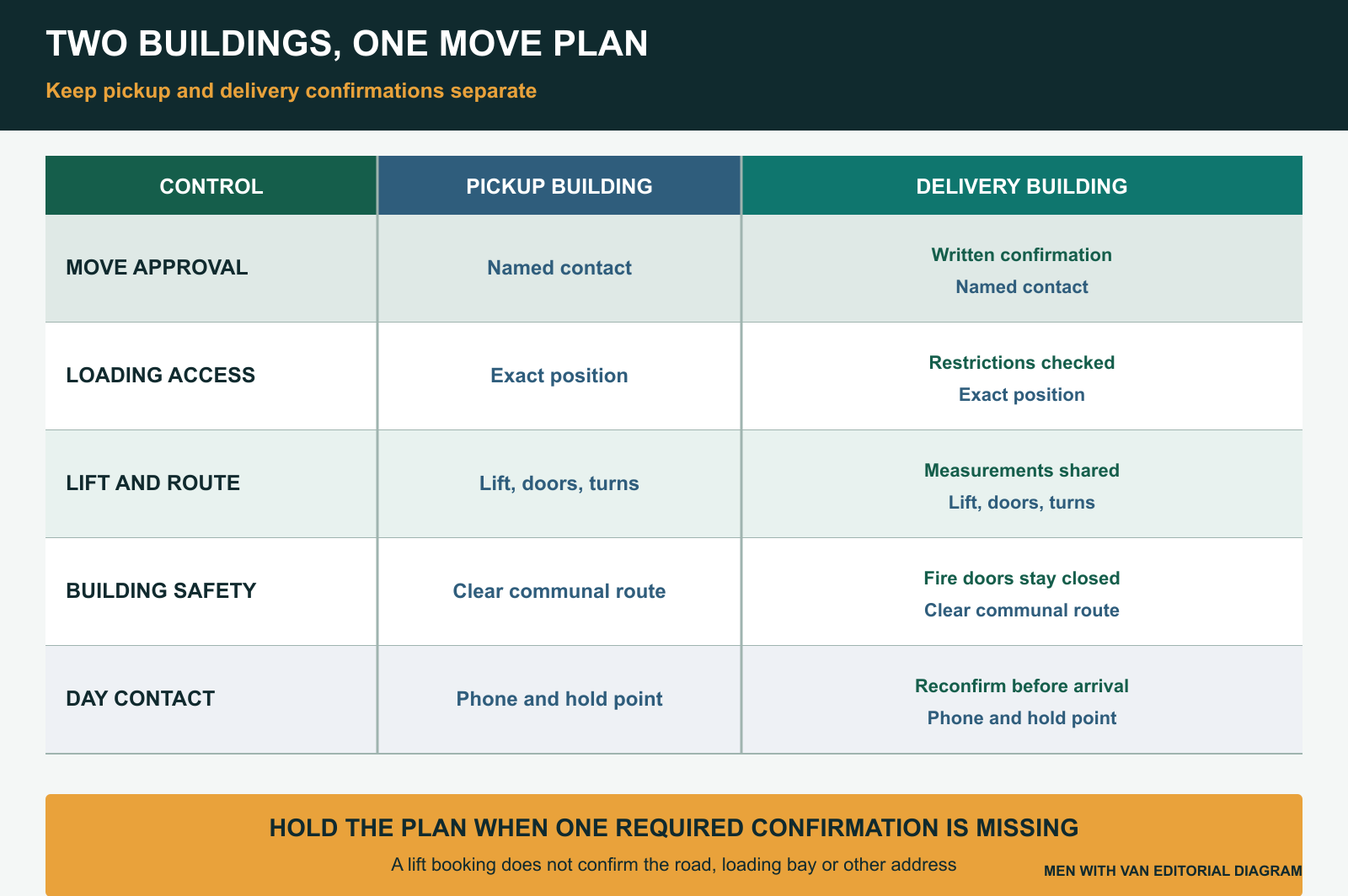
The register pairs pickup and delivery evidence, gives each missing action an owner and creates a visible hold point before uncertain access reaches moving day.
Create one row for every dependency that can stop or materially change the move. Keep pickup evidence and delivery evidence in separate columns, then name the person responsible for closing the question. A blank cell is not approval. Mark the row pending and state what document, measurement or confirmation is needed.
| Dependency | Pickup evidence | Delivery evidence | Action owner | Hold point |
|---|---|---|---|---|
| Move approval | Current manager instruction and approved window | Current manager instruction and approved window | Resident or named building contact | No fixed plan while either approval is pending |
| Road or private bay | Authority, signs, conditions and reference | Authority, signs, conditions and reference | Named applicant | No assumed vehicle position |
| Entrance and security | Door, fob, concierge and contractor process | Door, fob, concierge and contractor process | Building contact | No access code stored in the pack |
| Lift and internal route | Lift record, dimensions, turns and restrictions | Lift record, dimensions, turns and restrictions | Building contact and Men With Van reviewer | Bulky item route remains open until reviewed |
| Communal protection | Approved materials, staging point and supervision | Approved materials, staging point and supervision | Building contact | No obstruction of shared escape routes |
| Day contact | Name and tested contact method | Name and tested contact method | Customer | No silent escalation path |
The register is a coordination tool, not a building approval or safety certificate. Attach the supporting evidence, record when it was checked and update the row when a condition changes.
Change control
Set hold points and recheck the live conditions
A useful checklist says when work must pause, who is contacted and which part of the plan needs reassessment when expected access is missing.
Set a hold point for every dependency that cannot safely be guessed. Examples include missing building approval, no lawful vehicle position, an unavailable concierge, a locked bay, a different lift, an unmeasured bulky item route, a blocked corridor or a delivery address that is not ready. State the contact and the evidence needed to release each hold point.
Send one final handover containing the two address records, dependency register, current approvals, route photographs, inventory, measurements, road status and open questions. The building access handover pack provides a printable structure, while the moving service price guide explains the main quote inputs. Neither document replaces live approval.
On moving day, compare the vehicle position, entrance, concierge process, loading point, lift and internal route with the confirmed record before handling begins. Report any change. Men With Van may need to alter the sequence, equipment, resources, time or scope. Do not force an earlier plan through conditions that the evidence did not cover.
Editors and property teams reviewing building access guidance can use the source checked moving resource library for the current guide collection and contact route. A library entry is not approval for a particular building or moving date.
Sources and checks
Official guidance used for this article
Rules, application times and charges can change. Check the road signs and the responsible authority again before moving day.
- Building Safety Regulator: actions to keep a high rise building safeChecked 29 July 2026
- London Fire Brigade: escape plans for blocks of flatsChecked 29 July 2026
- HSE: manual handling at workChecked 29 July 2026
- HSE: pushing and pulling risk assessmentChecked 29 July 2026
- HSE: passenger lifts and escalatorsChecked 29 July 2026
- TfL: parking and loading legallyChecked 29 July 2026
- London Councils: loading and unloadingChecked 29 July 2026
Common questions
High rise apartment move questions
How far ahead should I request approval for a high rise move?
There is no universal notice period. Ask the current building manager or concierge at both addresses, record the stated deadline and keep the move window pending until written approval is received.
Does a service lift booking also confirm the loading bay?
No. The lift, loading bay, entrance and public road position can have different owners and booking records. Confirm each dependency separately at pickup and delivery.
Can a removal team use the passenger lift?
Only when the building permits it and the route is suitable for the proposed task. The presence of a passenger lift is not permission to use it for furniture or equipment.
What happens if the lift or concierge is unavailable on the day?
Pause the affected part of the plan and contact the named building representative. Men With Van may need to reassess the route, sequence, resources, time or scope before continuing.
Who normally arranges building approval?
The customer usually requests it because building management may only discuss an apartment with the resident. Men With Van can review the supplied rules and access evidence for the proposed move.
Can boxes or furniture wait in a communal corridor?
Do not assume so. Follow the current building instruction and keep shared escape routes and fire doors clear. Record an approved staging point or sequence items from the apartment and vehicle.
Coordinate both addresses
Send the two building dependency register before the move plan is fixed.
Give Men With Van the current approval records, road status, loading details, lift evidence, route photographs, inventory and open questions for pickup and delivery so the actual move can be reviewed.