Original London authority source audit
London parking suspension notice periods across 33 authorities
This comparison records the application guidance published by every London authority without turning working days, calendar days, short notice fees or evidence gaps into one misleading score.
At a glance
What this guide helps you organise
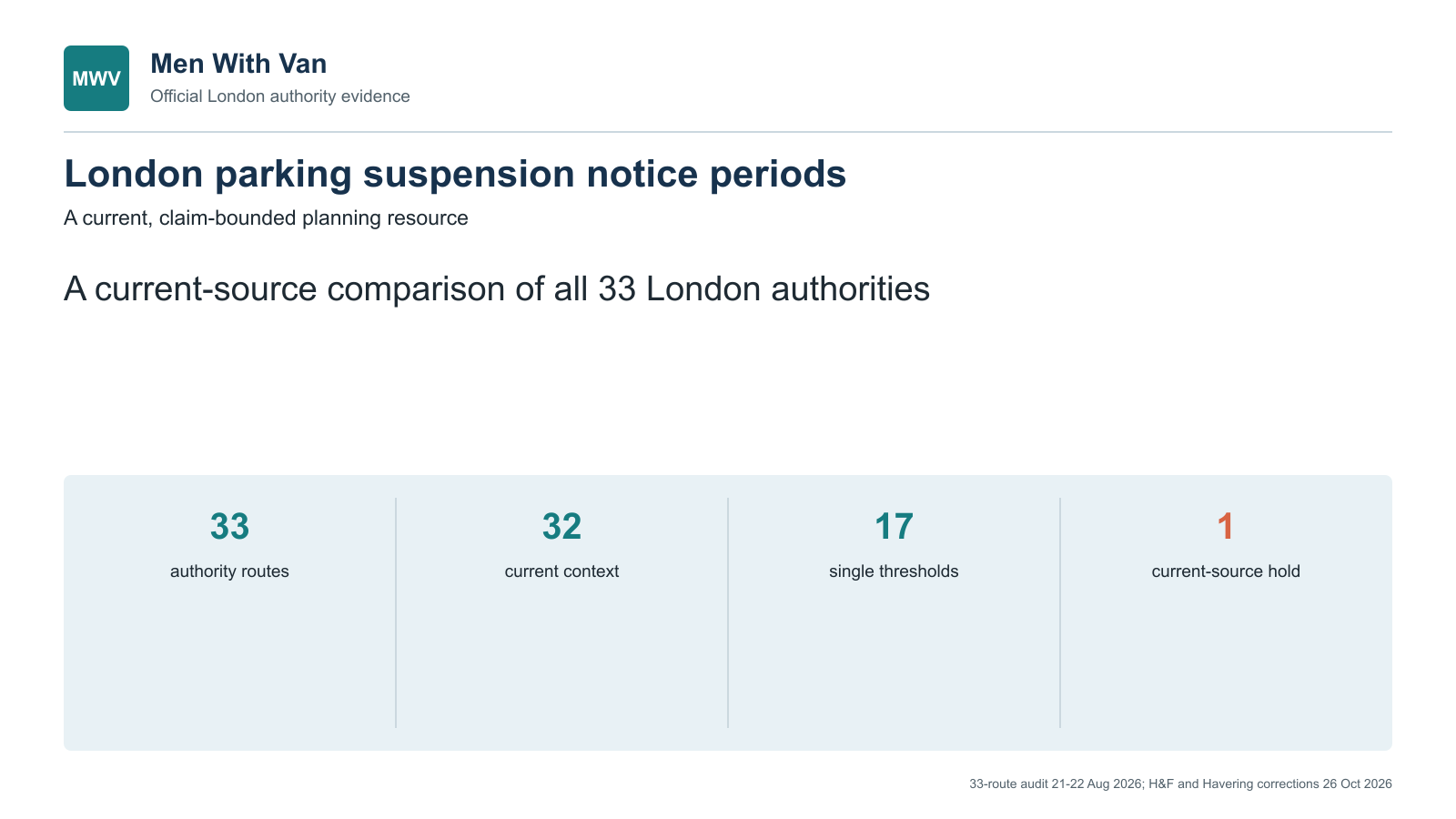
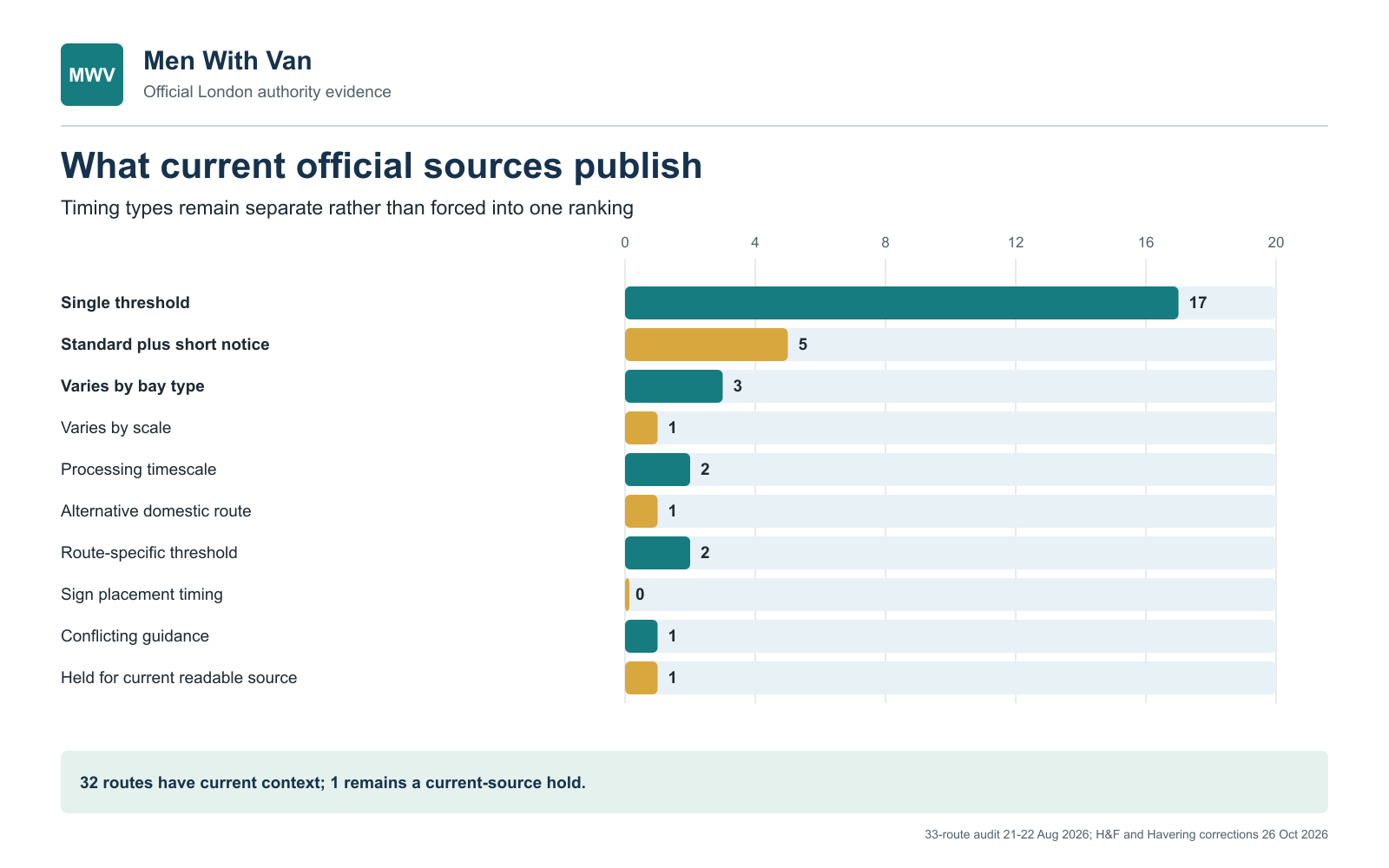
- Thirty two authority routes have current readable timing or route context; Barnet remains held because its cited current route was unreadable. Havering's five-working-day route is limited to utility and street work companies.
- Seventeen current rows publish one main application threshold.
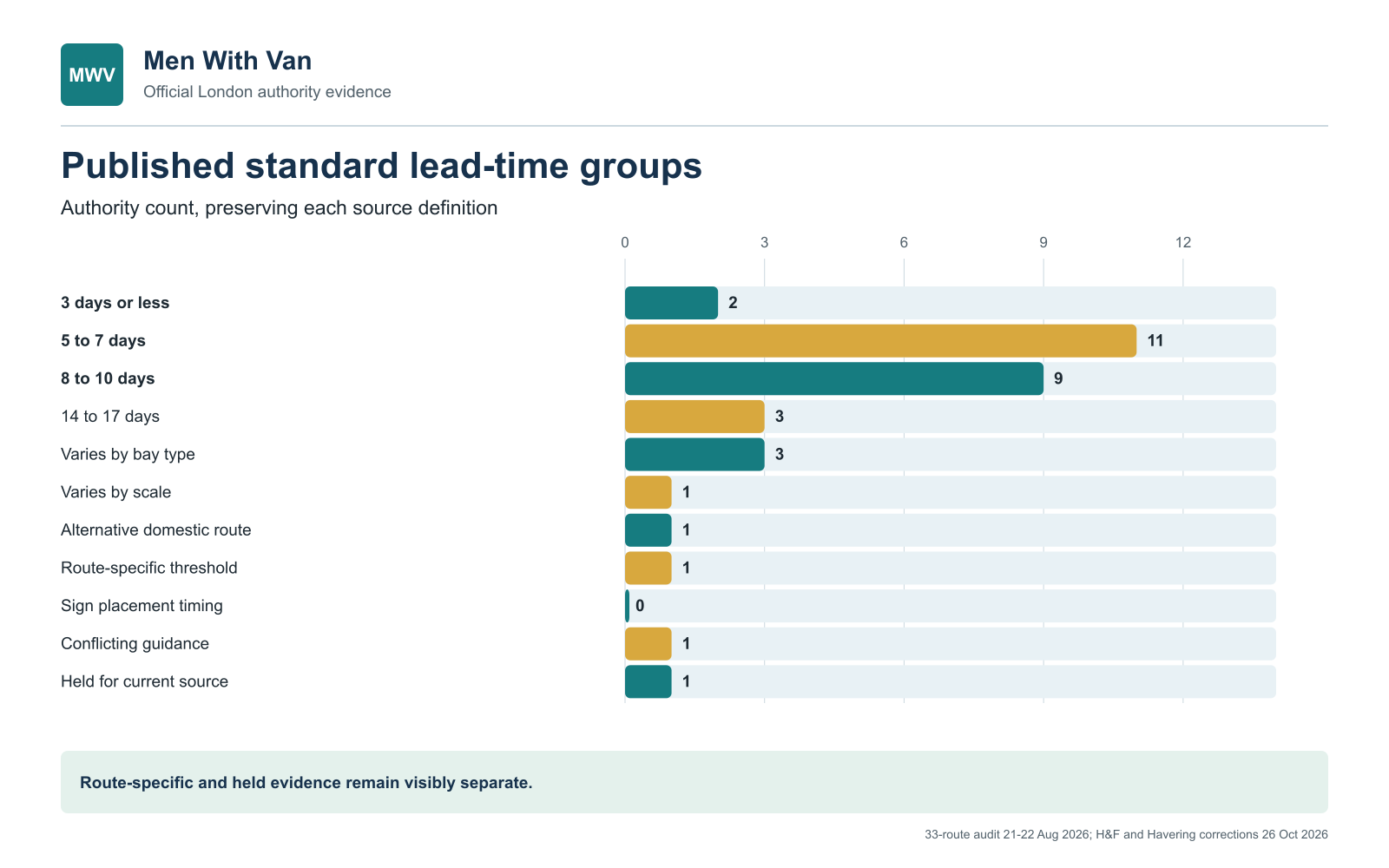
- Eleven rows fall in the five-to-seven-day group, nine in the eight-to-ten-day group and three in the fourteen-to-seventeen-day group, while each source's own day definition still controls.
- Waltham Forest publishes a route-specific 14-day threshold for development-related highways works; it is not presented as a universal domestic-move deadline.
- A request does not guarantee approval, an empty bay, lawful road use or suitable vehicle access.
Planning evidence
What this comparison records and why it matters
A removal vehicle can only use the street space that the responsible authority and current signs allow, so the application date is part of the access plan rather than an administrative afterthought.
Men With Van reviewed one current official source for each of the 32 London boroughs and the City of London. The comparison records the main published application period, any shorter request band or bay type variant, the source wording about time, whether removals are named on that source, the published application route and the date checked.
The purpose is practical. A move date may be agreed weeks before the responsible council has approved a suspension. If the application window is missed, an authority may charge more, decline the request or offer only a different route. Even an approved suspension may not guarantee that the bay is empty when the vehicle arrives. The separate London removal parking fee comparison applies one domestic moving scenario to the public fee evidence without treating unclear cases as exact totals.
This is not a league table and it does not rate councils. A shorter period is not automatically better, because the source may be describing processing rather than an application minimum, or a late request that is not guaranteed. A longer period may reflect the warning needed for resident bays. The full wording stays beside every value so a reader can see what was actually published.
Transparent method
How the 33 authority source audit was built
The audit uses official council pages and documents only, preserves the authority's own time basis and marks missing or conflicting evidence instead of estimating it.
All 33 authority rows were compared with official public evidence on 21 August 2026, with Barnet, Camden and Enfield revalidated on 22 August. Hammersmith and Fulham and Havering were rechecked on 26 October. Thirty two have current readable or indexed official timing context. Barnet remains held because its cited current route was unreadable; historical timing is not presented as current.
Working days, calendar days, clear days and weeks remain in the source's own terms. Alternative domestic routes, sign-placement timing and processing times are kept outside the main application-threshold groups.
London wide pattern
Most published standard periods sit between five and ten days
Eleven current authorities are in the five to seven day group, nine are in the eight to ten day group and three are in the fourteen to seventeen day group, but the full source definition still controls the real deadline.
Among current rows, two sit at three days or less, eleven in the five-to-seven-day group, nine in the eight-to-ten-day group and three in the fourteen-to-seventeen-day group. Hillingdon publishes conflicting current guidance by source and bay type; Islington and Kensington and Chelsea vary by bay type; City of London and Redbridge publish processing times. Hammersmith and Fulham varies by request scale, and Havering is a route-specific utility and street work process. Barnet is held outside these current groups.
Enfield routes moving house to a separate dispensation, Waltham Forest has a route-specific development-related threshold, and Richmond contains conflicting guidance. Those distinctions are not forced into a false single-day ranking.
Complete source table
Parking suspension notice guidance for all 33 authorities
Open the authority name for the current official source, then read the shorter request or variant column before treating the main period as the application deadline.
Use the Left and Right Arrow keys when this table region has focus to pan through all columns.
| Authority | Published standard notice | Short notice or important variant | Source status |
|---|---|---|---|
| Barking and Dagenham | 5 working days | A longer period may be required in some cases | Single threshold |
| Barnet | Historical snapshot only - current official route unreadable | Confirm the current requirement directly before fixing a move date | Held for current readable source |
| Bexley | 3 working days | Late applications may not be approved by the requested start | Single threshold |
| Brent | 7 working days | Applications inside 14 days attract a higher fee | Single threshold |
| Bromley | 3 working days | No shorter published application window is stated | Single threshold |
| Camden | 17 days | Minimum 3 days; the short notice charge is waived for moving home | Standard plus short notice |
| City of London | 6 working days | A vehicle standing in a suspended bay also needs a dispensation | Processing timescale |
| Croydon | 10 working days | No shorter published application window is stated | Single threshold |
| Ealing | 7 working days | Minimum application window is 3 working days at a higher daily charge | Standard plus short notice |
| Enfield | 10 working days for the suspension route | Moving house is routed to a separate temporary dispensation that does not reserve a bay | Alternative domestic route |
| Greenwich | 10 working days | No shorter published window stated | Single threshold |
| Hackney | 7 working days | Late applications may be considered with an additional fee | Single threshold |
| Hammersmith and Fulham | 8 days for up to six bays for up to three days | 2 weeks for listed larger or longer requests; 4 weeks for more than 12 bays or more than one week | Varies by request scale |
| Haringey | 2 weeks | Changes should be requested at least 8 working days before the start | Single threshold |
| Harrow | More than 10 working days for the standard administration band | Applications received from 3 to 10 working days and under 3 working days have separate bands | Standard plus short notice |
| Havering | 5 working days for the utility and street work route | Only utility and street work companies can apply; do not treat this as a general removals route | Route-specific threshold |
| Hillingdon | Conflicting current guidance: the application page states 7 full working days for permit-holder, shared-use, business and disabled-person spaces and 5 full working days for pay-and-display, loading, motorcycle and taxi-rank spaces; the 2026/27 fees schedule states 10 working days for resident bays and 5 working days for pay-and-display | Confirm the applicable minimum with Hillingdon before fixing a move date | Conflicting current official sources |
| Hounslow | 10 working days | Exceptions may be considered for evidenced emergencies | Single threshold |
| Islington | 10 days for Pay By Phone bays and 14 days for all other bay types | Late requests may attract an additional fee or be declined | Varies by bay type |
| Kensington and Chelsea | 10 working days for permit bays; 2 working days for pay-by-phone bays | Permit-bay requests up to 5 days may be considered at council discretion with an additional charge | Varies by bay type |
| Kingston upon Thames | More than 1 week for the standard fee band | Applicants needing a start inside 5 days must telephone the council | Standard plus short notice |
| Lambeth | 10 or more working days | Short notice is 6 to 9 working days and express short notice is 2 to 5 working days | Standard plus short notice |
| Lewisham | 5 working days | No shorter published window stated | Single threshold |
| Merton | 10 full working days | Signs are normally placed seven days before the start | Single threshold |
| Newham | 10 working days | Applications with less notice may be rejected | Single threshold |
| Redbridge | Up to 7 working days to receive a decision | Changes to the location or start date are not normally possible with less than 5 working days notice | Processing timescale |
| Richmond upon Thames | Conflicting current guidance: 10 working days in the page introduction and 7 working days in the application section | More than 8 bays need at least 10 days | Conflicting guidance |
| Southwark | 7 days | Emergency work is the stated exception | Single threshold |
| Sutton | 7 working days | Urgent applicants are directed to contact the parking team | Single threshold |
| Tower Hamlets | 7 days | The council aims to process applications within 2 working days | Single threshold |
| Waltham Forest | 14 days on the development-related highways works route | Separate suspension guidance aims to place warning notices 5 to 7 days before the start; this does not establish a universal domestic application deadline | Route-specific threshold |
| Wandsworth | 7 clear working days | The day of submission is excluded and applications after 3pm count from the next working day | Single threshold |
| Westminster | 10 working days | Granted requests inside 10 calendar days attract a short notice administration charge | Single threshold |
Download the full source checked CSV
The CSV adds the time basis, whether removals are explicitly named on the reviewed source, the application route, source title, source URL, check date and a plain editorial note for every authority.
Important distinction
Application time, processing time and street warning time are different
Several authority pages publish more than one clock, and using the shortest number can create a false deadline.
An application period, a processing time and the period for displaying street notices are different clocks. City of London and Redbridge publish processing wording, Merton separately describes sign placement, and Waltham Forest's general suspension guidance describes a five-to-seven-day warning-sign aim while a separate development-related highways works route publishes a 14-day threshold. The separate threshold is not treated as a universal domestic deadline.
Count backwards using the current authority definition and follow the route that applies to the exact bay type, request scale and purpose.
Operational limits
A parking suspension is only one part of the moving access plan
The authority controls the road restriction, but the mover still needs a lawful route, enough usable length, building permission and a plan for an obstructed bay.
A suspension temporarily changes the use of a defined parking space or bay. It does not grant permission to stop on a red route, obstruct traffic, use a private road, occupy an unsuitable loading position or ignore a loading ban. Transport for London controls red routes, while borough councils usually control local parking bays. Check the sign and the responsible authority for the exact street.
The application should describe the real vehicle and work. Confirm the vehicle length and any tail lift operating space before choosing the number of bays. Record whether the suspended area is adjacent to the entrance, how far goods must be carried, whether the kerb or footway affects the route, and whether a banksman or separate traffic arrangement is required.
Building access remains separate. A confirmed bay does not book a service lift, approve protective coverings, release keys, reserve a loading dock or authorise access through a shared entrance. The service lift booking guide and high rise access checklist cover those building controlled decisions.
Keep a fallback. Several councils state that they cannot guarantee an authorised bay will be free. Record the enforcement contact, suspension reference, vehicle registration and a safe alternative stopping plan before the crew arrives. Do not use cones, bins or a private vehicle to reserve public road space without authority approval.
Useful handover
What movers, residents and property teams should record
A compact evidence handover prevents the suspension reference, bay location and building plan from becoming separate conversations on the morning of the move.
Start with the full pickup and delivery addresses, move date, vehicle registration and dimensions. Add the authority name, source URL, bay type, exact location, requested length, application date, payment status, suspension reference, approved dates and approved purpose. Save the authority confirmation and a current image of the street sign.
Then connect the street record to the building record. Name the building contact, service lift slot, loading dock or concierge instructions, door and lift measurements, protection rules, access keys and any restricted working hours. The responsible person should confirm unknowns before vehicle and crew assumptions are fixed.
- Identify the authority that controls the exact road.
- Read the current official page and count back using its own day definition.
- Confirm whether the chosen bay type changes the application period.
- Apply with the real purpose, vehicle and space requirement.
- Keep the approval, reference, sign image and enforcement contact together.
- Confirm building access separately and record a safe fallback if the space is obstructed.
The London moving day parking guide explains the broader sign, loading and red route checks. The moving access worksheet records the route inside the property. Neither resource submits an authority application or confirms that a bay is approved.
Update and reuse policy
How the data will be corrected and maintained
The source URL, check date and qualification travel with every row so a correction can change one authority without rewriting the evidence for the other 32.
This is the first published edition of the comparison. A material source change, corrected interpretation or authority response will receive a new modified date and a plain note in the affected row. Historic copies should be treated as a record of what the cited source stated on the check date, not as a permanent deadline.
The CSV may be reused with attribution to Men With Van for the compilation and to the named authority for its guidance. Reusers should retain the source URL, check date, time basis and editorial note. Retain the Hammersmith and Fulham request-scale bands and the 26 October 2026 source-check date, retain Havering's utility and street work scope and the Richmond conflict note, and do not turn the lead time groups into a performance ranking.
For a correction, send the authority name, the field in question and a current official source to info@menwithvan.com. Men With Van will not replace a published authority value with an uncited commercial directory claim. Journalists, housing teams and property editors can use the media and expert resource library for the downloadable file and contact route.
Sources and checks
Official London authority sources checked for this comparison
All 33 authority rows were rechecked against official public evidence on 21 August 2026, with Barnet, Camden and Enfield revalidated on 22 August. Hammersmith and Fulham and Havering were rechecked on 26 October. Hillingdon's current official sources conflict and Barnet remains held for direct readability. Havering's five-working-day route is restricted to utility and street work companies. Recheck each current authority page before applying because forms, notice periods, fees and local arrangements can change.
- Barking and Dagenham parking bay suspensionChecked 21 August 2026
- Barnet parking suspensions and dispensationsRechecked 22 August 2026; current route held for direct readability
- Bexley parking dispensations and suspensionsChecked 21 August 2026
- Brent parking suspensions and dispensationsChecked 21 August 2026
- Bromley parking dispensations and suspensionsChecked 21 August 2026
- Camden parking bay suspensionsChecked 22 August 2026
- City of London parking suspensions and dispensationsChecked 21 August 2026
- Croydon parking restriction suspensionsChecked 21 August 2026
- Ealing parking bay suspensionsChecked 21 August 2026
- Enfield parking suspensions and dispensationsChecked 22 August 2026
- Greenwich apply to suspend a parking bayChecked 21 August 2026
- Hackney parking bay suspensionChecked 21 August 2026
- Hammersmith and Fulham suspensions and road closuresSource correction checked 26 October 2026; notice varies by bay count and duration
- Haringey parking bay suspensionChecked 21 August 2026
- Harrow parking suspensions and dispensationsChecked 21 August 2026
- Havering parking bay suspensionsSource-scope correction checked 26 October 2026; route is for utility and street work companies
- Hillingdon application guidance by bay typeChecked 21 August 2026; conflicts with the current fees schedule
- Hillingdon fees and charges 2026 to 2027Checked 21 August 2026; conflicts with the current application page
- Hounslow request a parking suspensionChecked 21 August 2026
- Islington suspend a parking bayChecked 21 August 2026
- Kensington and Chelsea suspension notice periodsChecked 21 August 2026
- Kingston apply for a parking suspensionChecked 21 August 2026
- Lambeth parking suspension notice periodsChecked 21 August 2026
- Lewisham parking bay suspensionChecked 21 August 2026
- Merton suspending parking bays and yellow linesChecked 21 August 2026
- Newham resident parking bay suspensionsChecked 21 August 2026
- Redbridge suspend a parking bayChecked 21 August 2026
- Richmond parking suspensionsChecked 21 August 2026
- Southwark parking bay suspensionChecked 21 August 2026
- Sutton parking dispensations and suspensionsChecked 21 August 2026
- Tower Hamlets parking customer charterChecked 21 August 2026
- Waltham Forest development related highways worksChecked 21 August 2026
- Wandsworth parking bay suspension applicationChecked 21 August 2026
- Westminster parking bay suspensionsChecked 21 August 2026
Common questions
Questions about London parking suspension notice periods
How much notice does a London parking suspension need?
It depends on the authority, bay type and request route. Most principal published periods in this study sit between five and ten days, but the source may use working days, calendar days, clear days or weeks.
Can I submit a parking suspension at short notice?
Some authorities publish a shorter request route or fee band, but approval is not guaranteed. Read the current source and confirm the date directly before relying on a late application.
Does an approved suspension guarantee an empty bay?
No. Several authorities state that they cannot guarantee a suspended space will remain clear. Keep the approval reference and the authority enforcement contact available on moving day.
Are working days and calendar days treated the same?
No. The comparison preserves the wording used by each source. Working days, clear working days, calendar days, clear days and weeks should not be converted without checking the authority's instructions.
Why does Hammersmith and Fulham have several notice periods?
Its current public parking-suspension page varies the period by bay count and duration: eight days for up to six bays for up to three days; two weeks for specified larger or longer requests; and four weeks for more than 12 bays or more than one week. It does not expressly name removals, so confirm the route and purpose before applying.
Does this page apply for a suspension on my behalf?
No. This is a source comparison. Use the official authority route for the exact street and keep the authority confirmation with the moving access record.
Plan the actual move
Connect the authority approval to the building access record.
Share both addresses, the exact vehicle, bay approval, carrying distance, floor, lift, item list and current access evidence so the move plan reflects the real route.