Keys / Broadband / Essential calls
Moving home in London: broadband and digital landlines
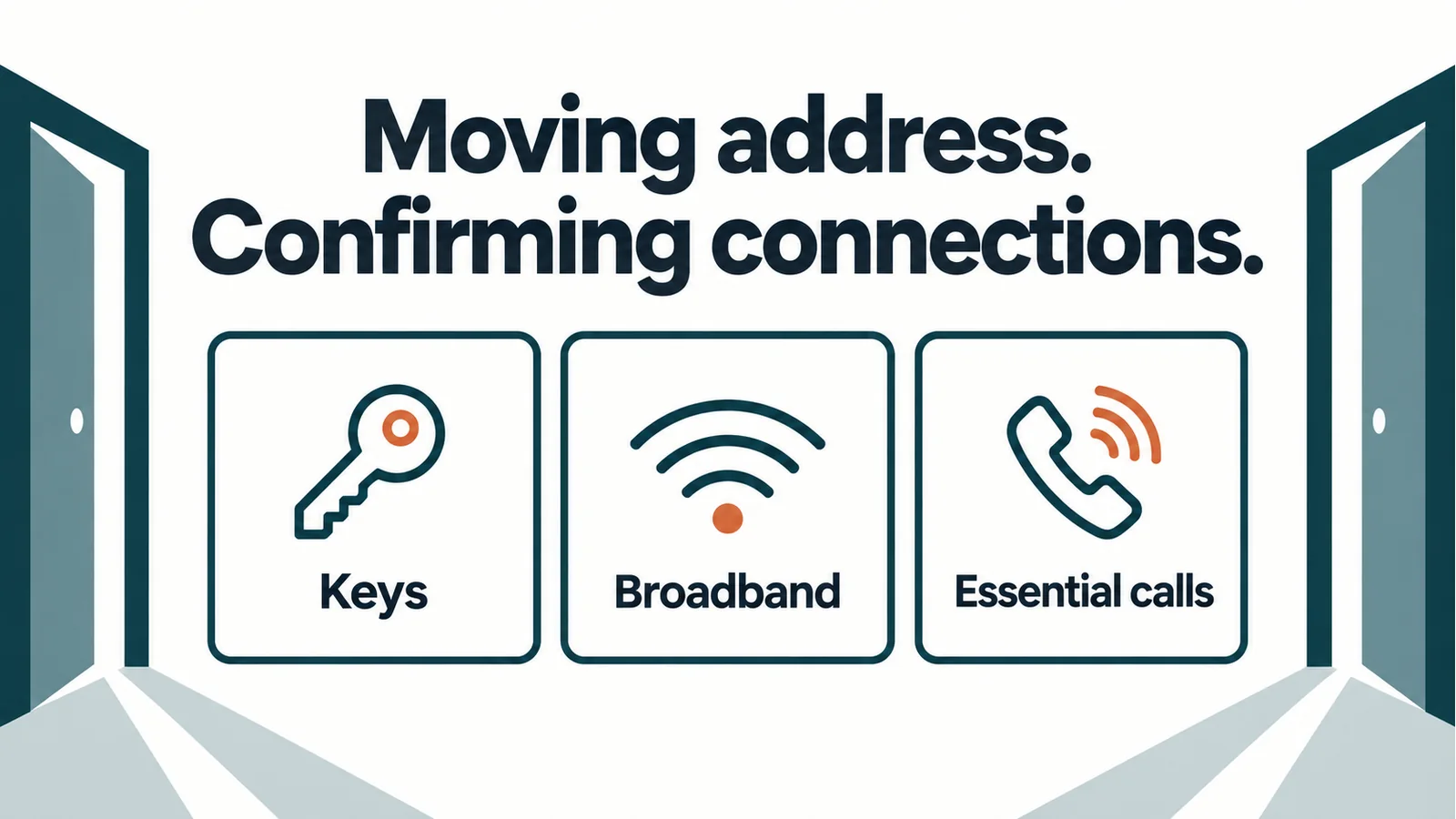
Before you pack the router, confirm three things separately: when you can enter the new home, when its broadband service is due to work, and how the household will make essential calls. A removal booking confirms none of these telecoms arrangements. Equally, a broadband order is not evidence that you will have the keys in time for an engineer.
For a London move this autumn, the useful question is not simply "Have I told the broadband company?" It is "Which address, service, equipment and date has the company actually confirmed?" Keep those answers together, then give the removal team only the practical information they need. Your account password, telephone security answers and personal circumstances do not belong on a moving-box label.
This guide offers a household handover method, not a broadband comparison or installation service. It keeps the provider's technical decisions separate from packing, access and moving-day coordination.
Why a move now deserves a closer look at the phone line
Ofcom's digital-landline guidance, updated on 26 August 2026, says BT plans to retire its old landline network by 31 January 2027. It distinguishes this from other networks whose retirement dates are not yet set. Do not turn the BT date into a claim that every household has the same deadline. Ask your own provider what applies to both addresses. Ofcom: digital landlines.
The practical point for a mover is that the old property's arrangement is not a specification for the new one. A familiar handset, a working wall socket or a seller's description of the broadband is not your service confirmation. Photograph the relevant equipment privately, ask the provider to identify what is needed, and keep its answer with the order reference.
Treat three events as separate until the provider confirms otherwise: moving address, changing supplier and changing phone technology. They may happen together, but planning them as one event can hide an unanswered question. For example, the household might know where to plug in its router but still not know how the phone service will be provided.
Moving address is not just switching supplier
Ofcom's switching guidance, updated on 25 August 2026, describes One Touch Switch as a process managed by the new provider. That provider explains any installation or equipment requirements. The guidance also identifies possible effects on bundled services and provider-supplied email. Ofcom: switching broadband provider.
Do not assume that following a supplier-switch journey also arranges a change of address. Tell the provider explicitly that you are moving home and ask which process it is applying. Ask it to confirm which service will end at the old address and which order will start at the new one. Avoid issuing a separate cancellation merely because a website says switching is simple; first establish what the agreed process already does.
Openreach's moving-home guidance directs customers to their broadband provider. It says setup times depend on the connection and work required, and that the provider will confirm expected readiness after an order. Availability at the new address and contractual arrangements need checking rather than assuming the current service transfers unchanged. Openreach: moving home.
Ask for the answers in a form you can find again. A short saved confirmation is more useful on moving morning than trying to reconstruct three calls. If information conflicts, ask the provider to reconcile it before treating any date as settled.
Use a five-line connectivity handover
The following is an original MWV planning tool. It does not replace a provider's order or guarantee uninterrupted service. Complete it privately; share only the relevant arrival and access details with the removal team.
| Decision | What to record | What counts as an unresolved item |
|---|---|---|
| New address | Exact flat or house identifier and the address used on the order | The order identifies the building but not the correct dwelling |
| Property access | Who will hold the keys and any access arrangement for the appointment | Nobody can confirm entry during the proposed visit |
| New service | Provider, order reference, expected start and any installation appointment | Only a requested date or general availability result exists |
| Old service | The agreed end arrangement and any equipment-return instructions | Cancellation and the move order give conflicting instructions |
| Household fallback | A practical plan for ordinary communications, plus provider-led arrangements for essential dependencies | A plan relies on a signal, device or support arrangement that has not been checked |
Keep "requested" and "confirmed" visibly different. This is a small distinction with a large planning benefit: the person booking the van should not have to guess whether another household member's preferred installation date has actually been accepted.
For flats, copy the address precisely from the provider's confirmed order. If there is a mismatch, have the provider resolve it; do not order against a neighbouring flat as a workaround. Where an appointment involves communal areas, establish who can authorise and provide access. Do not promise an engineer entry that you cannot arrange.
Decide what stays before anything is packed
Openreach says its Optical Network Terminal, power supply and fixed fibre cabling remain at the property when you move out. An ONT is distinct from the broadband router. This is guidance for Openreach infrastructure, not a visual test for every box installed by every network. Openreach: equipment in your home.
Make a simple equipment decision before packing: stays, travels, returns, or needs confirmation. Ask the provider about uncertain items, including supplied routers and accessories. Do not assume a portable-looking power supply belongs in your cable box, or that everything bearing a provider's logo must be returned.
Use removable labels on your own packing containers, not on equipment controls or cables. A note in the room can identify infrastructure that the crew must leave alone. For an unidentified fixed device, the safe moving instruction is to leave it untouched pending confirmation, not to disconnect it and work out its purpose later.
Pack only equipment you have confirmed should travel, following its instructions and keeping the correct accessories together. Place essential personal communications items where the household can retrieve them without unloading the entire van. The wider first-48-hours essentials guide covers the rest of that immediate-use kit; there is no need to duplicate the whole list here.
Raise phone-dependent needs with the right people
Before a digital change, Ofcom says households should tell their provider about connected alarms, additional support needs or reliance on a landline without a reliable mobile alternative. Digital landlines need electricity; discuss power-cut arrangements with the provider rather than assuming the old phone's behaviour will continue. Ofcom: digital landlines.
The Department of Health and Social Care warns that some analogue telecare equipment may be incompatible with digital networks or perform less reliably. Its guidance directs users to their landline provider. Involve the alarm supplier too when confirming the actual device and service arrangements. DHSC: telecare and the digital phone switchover.
Keep these conversations with the household, its authorised supporter and the relevant providers. Movers should not decide whether a personal alarm is compatible, copy sensitive care information, or improvise a backup. Do not disconnect or test a care alarm on the strength of this article. Ask its provider how the move and any necessary checks should be handled. Never make an emergency call simply to test a line.
Only the operational consequence needs to reach the moving plan: an agreed appointment must be accommodated, a particular device must not be disconnected, or a named household contact must remain available. A private medical explanation is not required on the crew's load sheet.
Plan the gap, rather than promising there will not be one
For ordinary work and everyday communication, write down what the household would do if the new connection were not ready on arrival. Separate convenience from essential dependency. Streaming television, a work call and a phone-linked alarm are not interchangeable requirements, and a plan adequate for one may be unsuitable for another.
For a work-from-home arrangement, discuss any temporary location or approved connection with your employer before moving day. Check the practical details of whatever option you choose, including access, cost and suitability for your work. Do not make the removal crew responsible for finding a connection or handling private work equipment settings.
Keep important move contacts available offline. A printed appointment reference or saved local copy of the agreed arrival details can be useful when a phone cannot load an email. Leave passwords and account-security details out of anything shared with third parties.
Do not book every activity into one narrow window. An engineer needs someone who can answer technical and access questions; the removal team needs someone who can make decisions about unloading. Those may be different people. Name them in advance instead of assuming the same person can supervise both jobs from opposite ends of a building.
Two examples of a better handover
These are illustrative planning scenarios, not MWV customer stories or predictions of provider timescales.
A flat buyer has an installation appointment before key handover is certain. The moving date and the provider appointment appear to align, but the buyer cannot yet provide access. The useful action is to flag the dependency to the provider and property contact, record what each confirms and decide what happens if access changes. It is not to describe broadband as ready because an appointment appears in a calendar. Any removal-date consequences belong in a separately agreed moving arrangement.
A household's old router is packed with spare cables while a wall-mounted fibre box is mistaken for another accessory. The problem is an equipment decision, not a shortage of boxes. Before packing, the household asks its provider which equipment travels, which stays and which is returned. The crew receives a simple leave-in-place instruction for fixed infrastructure. On arrival, the household can find its confirmed travelling kit without unpacking unrelated possessions. No mover needs access to the broadband account.
Both scenarios show the value of making an uncertainty visible early. Neither is solved by claiming that every installation is fast, every network uses the same equipment, or every household can fall back on mobile data.
When a date changes
A property delay should trigger a review of the connectivity record as well as the removal booking. Contact the provider through its official route with the order reference and the changed circumstance. Ask it to confirm the revised service and appointment arrangements; record the response rather than assuming the old order has followed the new date.
The existing completion-day contingency guide covers the wider keys-and-removal problem. This article adds only the connectivity dependency. It does not change tenancy notice, contract terms, property access rights or your agreed removal conditions.
At the new home, follow the provider's setup instructions and confirm ordinary service operation through its supported process. Report a problem to the provider with the actual address and order reference. A successful furniture delivery is not telecoms acceptance, and an illuminated equipment light is not a reason to certify an alarm or specialist device.
What to tell Men With Van
For house removals in London, give us the agreed addresses, access details, moving inventory and any confirmed appointment constraints that affect loading or unloading. Identify equipment that should remain untouched and the household contact who can answer a packing question. Confirm the actual removal scope through your quotation; this article offers no installation, migration or uninterrupted-service promise.
Keep telecoms account management with your provider. A well-prepared move does not mean adding another person to a private account. It means that each person knows their own job, the dependencies are visible, and an unresolved connection is not hidden behind an apparently finished packing list.
Sources and method
This is an original operational planning synthesis checked on 19 September 2026, using Ofcom's consumer guidance updated on 25 and 26 August 2026, Openreach's current moving-home and equipment guidance, and DHSC's telecare guidance published on 13 May 2025. Openreach's two pages did not expose a publication date in the reviewed text; the check date is not their publication date.
The five-line handover and scenarios are MWV editorial tools, not regulator-prescribed forms. UK telecoms guidance is applied to London moving logistics; no London-specific network deadline is claimed. No survey, search-volume estimate, installation-duration promise or customer result has been inferred. Provider instructions, equipment arrangements and dates must be rechecked for the actual household.